 EN
A "Qualified Opinion" in the Audit Report: Is Your Hong Kong Company Really at Risk?


In month 5 of 2024, Hong Kong-listed Hop Fung Group (stock code 2320) issued a supplemental announcement. Its auditor issued a "qualified opinion" on its 2023 annual report for a very specific reason: the auditor could not obtain sufficient evidence to determine whether a tax expense of approximately 2362 ten thousand Hong Kong dollars should be recognized in 2022 or an earlier year.
This is not some shell company. It is a listed company.
......
First, let's be honest: when you see "qualified opinion," do not rush to treat it as a court judgment. It often addresses the recognition of a particular accounting item, rather than suggesting that the entire set of accounts is unreliable.
Yet online, far too many voices describe a qualified opinion as a "tax time bomb," say "the account will be frozen," or claim "three consecutive years means automatic striking off."
So, amid all this scaremongering, Taixia (WeChat ID: guotaixia321) will break it down today: what is true, and what is just meant to scare you.
What Exactly Is a Qualified Opinion, and Is It Compliant?
When many people hear "qualified," their instinct is to think "something is wrong" or "something is not clean." That instinct is only half right.
Audit opinions in Hong Kong fall into four categories: unqualified opinion, qualified opinion, adverse opinion, and disclaimer of opinion.
A qualified opinion is the lowest-risk category among "modified opinions," under the HKICPA's HKSA 705. It means that the financial statements as a whole are fairly presented, but for one or more matters, the accountant either considers there to be a material misstatement whose effects are not pervasive, or faces a limited restriction on the audit scope and cannot obtain evidence, without the matter warranting a more serious conclusion. Under HKICPA standards, a qualified opinion is itself a statutory, compliant type of audit opinion. It only indicates uncertainty about individual matters, while the financial statements as a whole still meet compliance requirements.
Hop Fung Group's amount of 2362 ten thousand is a typical example of a scope limitation. The question of which year the tax expense should be recognized in involves a written decision from the mainland tax authorities. The court has not yet issued a final ruling, and the accountant was unwilling to draw a conclusion on the company's behalf, so this item was "qualified." The rest of the company's accounts were accepted.
Qualified opinions generally fall into two categories:
Misstatement-related. For example, inventory was not counted in accordance with the rules, or a revenue item lacks compliant supporting documentation. The amount exceeds the materiality threshold, but only individual accounting items are affected.
Scope-limitation-related. For example, an overseas investment or a related-party transaction cannot be verified, and the accountant cannot send out confirmation requests, but the impact is limited.
Put plainly: the accounts are generally fine, but there is one part I cannot vouch for.
A qualified opinion is not a court judgment. It is a sticky note saying "uncertainty here."
Business owners operating across borders would do well to remember that.
The Line Independent Online Content Creators Most Often Use to Scare People
"Qualified opinions for three consecutive years = striking off"
This claim is widely circulated, but it gets cause and effect backwards.
The statutory basis for "striking off" a Hong Kong company is section 744 of the Companies Ordinance, Chapter 622. The Registrar of Companies may remove a company from the register when there is "reasonable cause to believe that the company is not carrying on business." The actual triggers are failure to file annual returns (NAR1) for two consecutive years, or failure to pay annual fees for two consecutive years.
So the issue is "failure to file annual returns," not "a qualified opinion in the audit report."
A qualified opinion itself has never been grounds for striking off by the Companies Registry. Taixia has searched through the Ordinance and cannot find any provision saying "we will deregister you because your audit opinion is unfavorable."
Then why do people conflate the two? Because a company that has gone several consecutive years without producing audit reports or completing its annual compliance review has very likely also failed to file NAR1 for several consecutive years.
It is the latter that truly pushes a company to the brink of being struck off. At most, a qualified opinion is a symptom of the company's "disorganized accounts," not the culprit.
Treating a "qualified opinion" as the cause of "striking off" means identifying the wrong culprit.
The flowchart below clearly sets out the two paths:
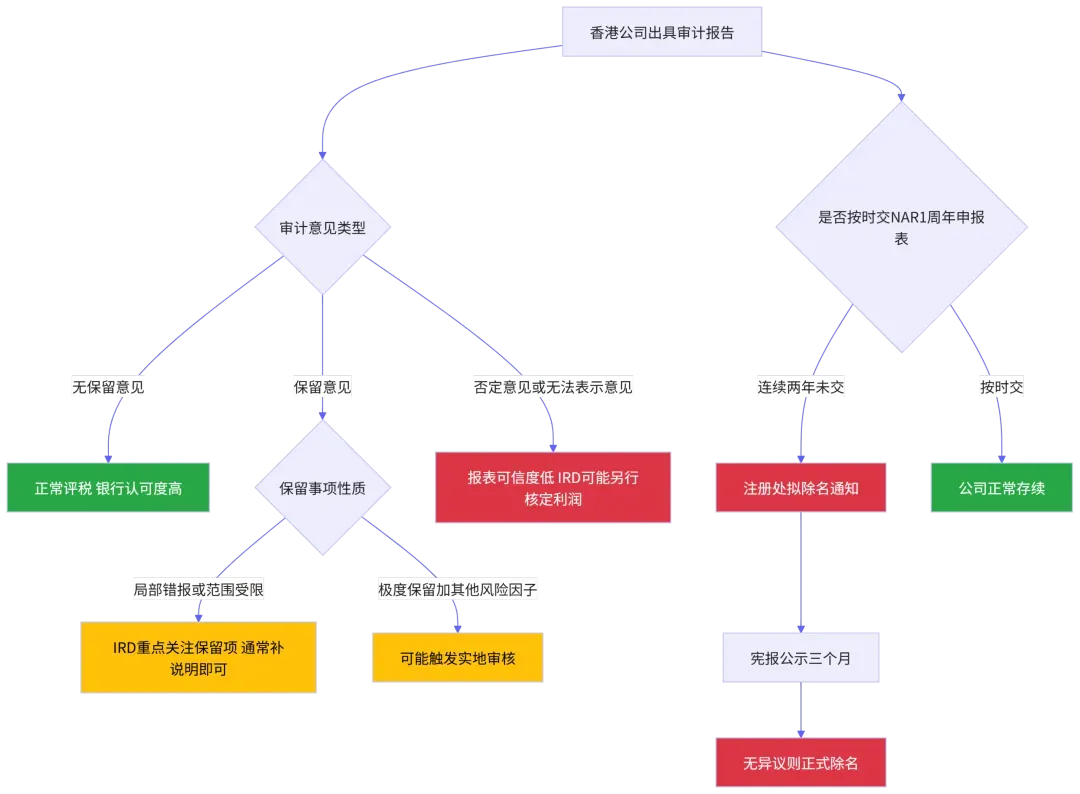
The path on the left is the "audit opinion" path, while the one on the right is the "annual compliance filings" path. Striking off follows the right-hand path. It and the qualified opinion on the left are two parallel lines.
How Does the Inland Revenue Department Actually Treat Qualified Opinions?
The Inland Revenue Department (IRD) officially explains how it selects cases for examination in Departmental Interpretation and Practice Notes No. 11 (DIPN 11). It lists selection criteria for field audits and investigations, including the following criterion relating to audit opinions:
The auditor expresses a "heavily qualified" opinion on a corporation's accounts in the audit report.
Pay attention to the word: heavily.
It means an extreme qualification, not an ordinary qualification. In an assessor's eyes, an ordinary qualified opinion will, at most, hold up the return for a little longer. Most likely, submitting a written explanation and the supporting documents for the qualified item will be enough for it to proceed. What actually triggers a field audit is an "extreme qualification" combined with other warning signs.
The other selection criteria listed in DIPN 11 are more worth checking against your situation:
Unreasonably low turnover or profit levels.
Persistent failure to file tax returns, or late filing.
Failure to keep proper business records.
Failure to provide important information requested by the assessor.
These characteristics matter much more than "whether there is a qualified opinion."
So, regarding the online claim that "a qualified opinion = a 30% chance of an IRD spot check," Taixia must remind you: this is an intermediary's claim, not an official figure. The Inland Revenue Department never publishes spot-check rates with that kind of percentage precision. It uses risk screening combined with random checks. A qualified opinion puts you in the queue for "a closer look," but it is far from "a guaranteed audit."
The truly high-risk opinions are adverse opinions and disclaimers of opinion. These effectively mean the accountant is saying, "I cannot trust these financial statements." Once you receive either of these opinions, the IRD may well reject your reported profits and recalculate them using other methods. The bank deposits method, the net worth method, and the business economics ratio method are all estimation methods specified in DIPN 11. At that point, submitting an additional explanation will not be enough to resolve the matter; the specific outcome depends on the IRD's handling of the individual case.
Three Types of Modified Opinions and Their Tax Consequences
Compare the three most common types of modified opinions side by side, and the differences become immediately clear:
| Dimension | Qualified opinion | Adverse opinion | Disclaimer of opinion |
|---|---|---|---|
| Reliability of financial statements | Generally reliable, with doubts about specific areas | Unreliable overall | Impossible to assess at all |
| IRD's stance | Focuses on the qualified items; additional explanations are often required | Highly skeptical; likely to initiate an investigation | Rejects the financial statements and determines profits separately |
| Bank's stance | Enhanced due diligence; possible inquiries or limits | Risk-control inquiries are highly likely, or account functions may be restricted | High risk; the account may be closed outright (depending on the individual case) |
| Offshore exemption application | Difficult; the IRD questions the authenticity of the data | Highly skeptical; approval is extremely difficult (handled case by case) | Highly skeptical; approval is extremely difficult (handled case by case) |
| Listing and financing | Financial statements for the past three years must be audited and free of material qualifications; the Stock Exchange requires explanations and remedial action for qualified opinions, and a serious impact on the true and fair presentation will impede listing | Does not meet the requirements | Does not meet the requirements |
| Will it directly lead to striking off? | No; there is no direct causal link to striking off | No; same as above | No; same as above |
Once you understand this table, you will see why Taixia says, "Do not demonize qualified opinions." They are the least severe of the three types.
What to Do in Practice If You Receive a Qualified Opinion
Now that we have covered the facts, here are some practical steps.
First, identify the type of qualification and the specific item involved. For a misstatement, provide the supporting documents for that item and correct the accounts; for a scope limitation, gather the confirmations, contracts, and bank statements. In many cases, once the missing materials are supplied, a qualified opinion can become an unqualified opinion the following year.
Second, do not delay. A qualified opinion for one year is not a problem. Repeated qualifications year after year without corrective action, combined with neglecting your annual compliance review, are what cause problems to snowball.
Third, retain a complete set of business supporting documents. Hong Kong's Inland Revenue Ordinance requires business records to be retained for seven years (section 51C), while the time limit for additional assessments is generally six years, extendable to ten years in cases of fraud or negligence. With complete documentation, even a qualified opinion is nothing to fear; with missing documentation, even an unqualified opinion cannot save you.
Final Thoughts
Taixia's position on qualified opinions has always been clear: they deserve your attention, but not your panic.
Articles that portray qualified opinions as the end of the world are written either by people who have not read the ordinance themselves or by people trying to frighten you into paying.
As long as you keep sound accounts, submit your annual compliance filings on time, and retain supporting documents for seven years, a qualified opinion is, at worst, a minor hiccup that needs an explanation.
"My company has always filed nil returns. Does it need an audit?"
Yes. Filing nil returns does not mean an audit is unnecessary. As long as the company operates and has account transactions, it must have an audit report prepared on time and attached to its tax return. If you submit only the return without the report, the IRD may treat it as a non-compliant filing, which is much more troublesome to rectify.
"If we receive a qualified opinion, can it become an unqualified opinion next year?"
Yes, provided the matter giving rise to the qualification has been resolved. Once the missing supporting documents have been supplied, accounting errors have been corrected, and the accountant has reviewed and confirmed everything is in order, an unqualified opinion can be issued the following year.
"Will the bank immediately freeze my account if it sees a qualified opinion?"
Generally, the account will not be frozen outright. Banks conduct enhanced due diligence and may ask you to submit additional explanations and supporting documents regarding the matters giving rise to the qualified opinion, or impose limits on certain account functions. Accounts are more likely to be closed outright in cases involving a "disclaimer of opinion" or suspected money laundering. The specific outcome depends on the bank's handling of each case.
If you found this useful, give it a like before you go. Let's pay a little less anxiety tax together.
Source: Kuajing Guo Taixia · Read the original article
Related Learning
From Losses to Profit: How User Experience Helped a DTC Store Achieve an ROI of Over 4 Within 3 Months | Shenzhen Topu Customer Case
A DTC store is not an advertising machine; it is a business built around user experience. I. Introdu…
How to Analyze Competitors on AliExpress? How to Grow a New AliExpress Store
In e-commerce, especially on international B2C platforms like AliExpress, understanding and analyzin…
How to Operate a Local AliExpress Store? AliExpress Store Registration Process
In cross-border e-commerce, AliExpress, as China’s largest online B2C foreign trade platform, has at…