 EN
AEO for growth marketing teams: How to find scalable acquisition channels when paid and organic plateau

Growth marketing is all about finding the next channel opportunity before the current one gets crowded and expensive. Paid search got crowded. Content took time. Email got filtered. The teams that found a new lever early on took advantage of lower competition, cost, and disproportionate returns before the channel normalized.

Right now, AI-driven discovery is that window of opportunity. Buyers are already using answer engines to research software categories, compare vendors, and form opinions about who the credible players are. Brands earning citations consistently are building awareness before buyers ever hit a landing page, and most of their competitors haven’t noticed yet.
Growth marketing teams need to connect AEO to acquisition metrics quickly enough to act on the signal and justify investment. The teams doing that now are building a playbook that will be much harder to replicate once the channel matures.
Identify which answer engine channels drive your highest-converting traffic.
Not all answer engines send the same kind of traffic. The buyer who discovers your brand through a Perplexity comparison is at a different stage than one who finds you in a general answer about your category. Knowing which answer engines drive the highest-intent visitors is the starting point for AEO resource allocation.
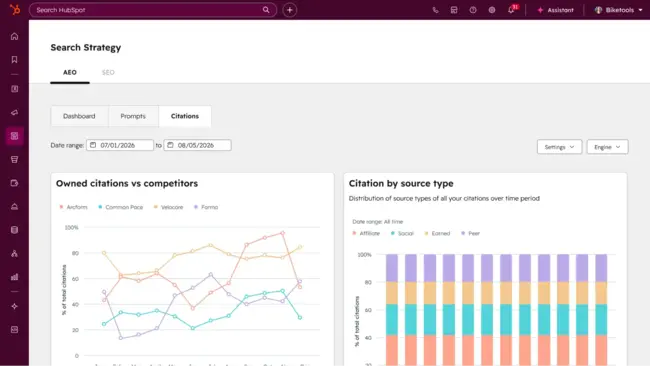
Growth teams that don’t know the sources of their AI-referred traffic treat AEO as a single channel and optimize generically. They waste resources spreading effort across engines, whether they send buyers or not. HubSpot AEO’s Brand Visibility Dashboard and citation analysis break down where your brand appears by engine and query type, so you can see which prompts drive the most valuable traffic.
Once teams know where the highest-converting AI traffic originates, marketers can focus on how to produce enough content to capture demand at scale.
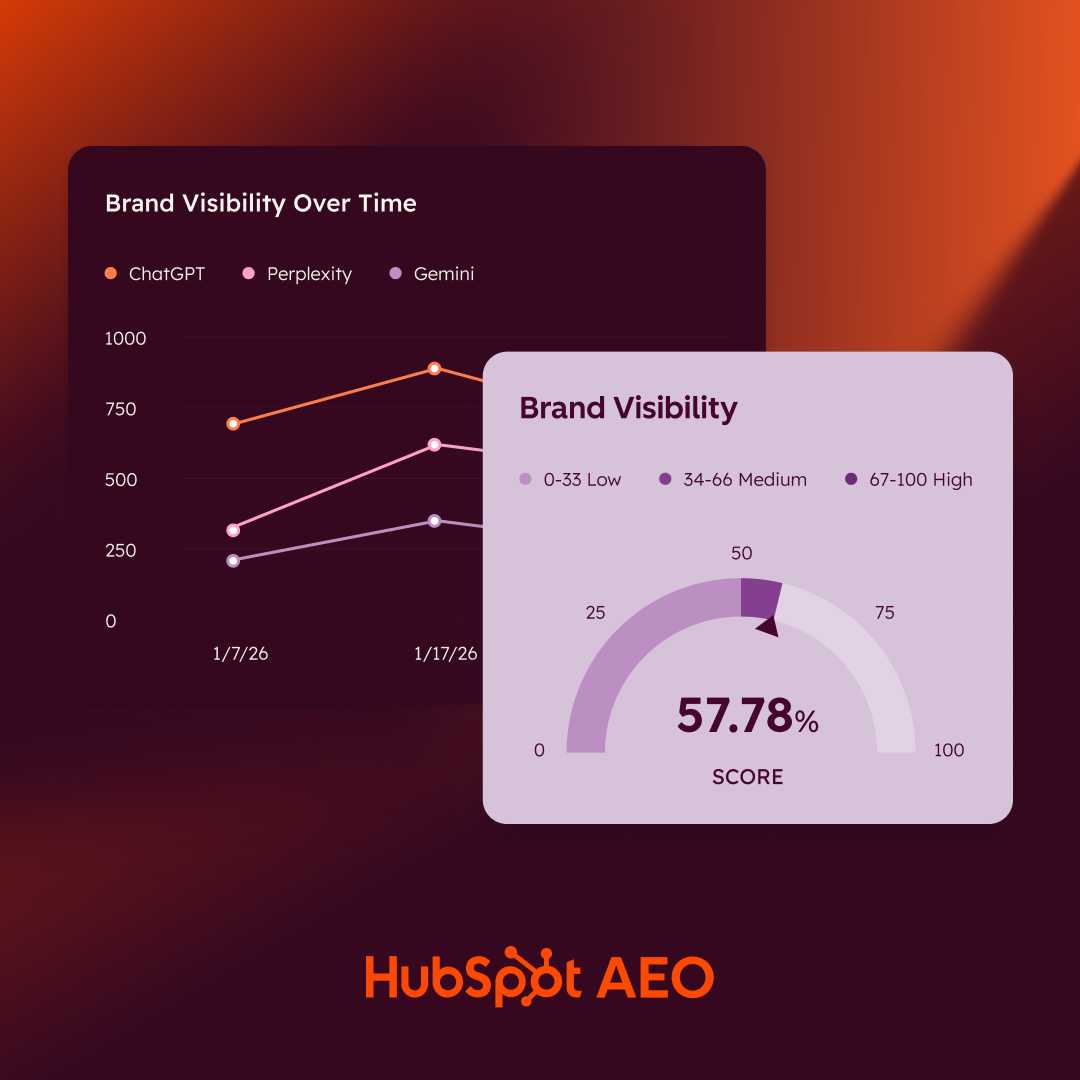
HubSpot AEO Tool
See exactly where your brand shows up in answer engines and take action to close AI visibility gaps.
- Track AI mentions.
- Analyze citations
- Monitor prompts
- Benchmark competitors
Scale content production to capture AI-driven discovery.
AEO-ready content is specific and structured, and directly answers well-defined questions in formats that answer engines can excerpt and cite. But it takes more than a quarterly blog to build meaningful share of voice across a category.
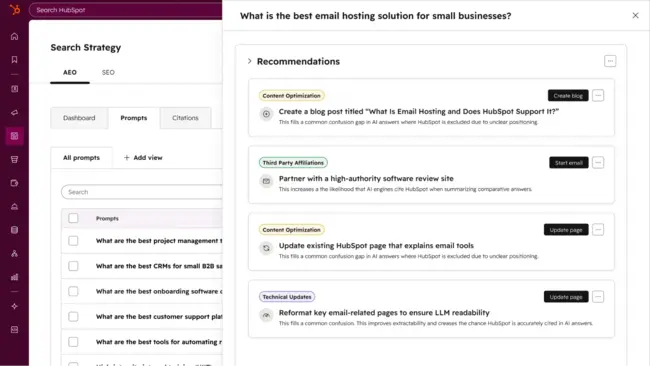
To dominate category questions before competitors, growth teams need a faster content cadence than traditional brand awareness campaigns. Content agent in HubSpot is built to create the content types and structures that earn AEO citations. Paired with Recommendations, which identify the specific questions and formats your content library is missing, content agent scales production in a targeted way, addressing content gaps with the highest citation potential.
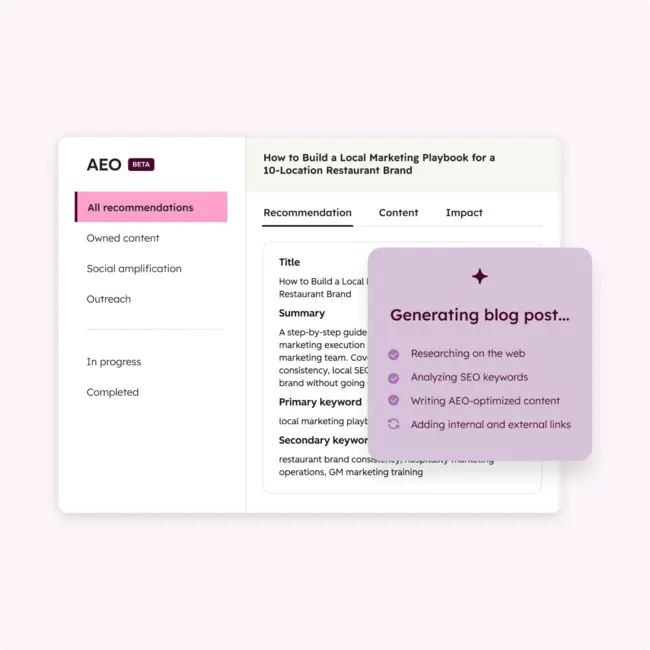
When HubSpot AEO tells you what to create, content agent drafts a research-backed blog post using your brand voice, ICP data, and real citation data. Your CRM data informs smarter prompts, content agent handles the research and writing, and you publish without switching platforms.
Scale matters, but it’s only worth it if you can attribute the results. To do that, teams need to connect AEO activity to acquisition metrics.
Connect AEO investment to acquisition metrics and pipeline.
Growth marketing teams live in acquisition data like cost per lead (CPL), customer acquisition costs (CAC), conversion rates, and pipeline velocity. To warrant sustained investment over experimentation, AEO needs to show up in those terms.
HubSpot’s data model lets you connect AEO visibility to contact and deal records. Once you tag AI-referred contacts and build the reporting views, you can track how AI-referred visitors move through your acquisition funnel, from first touch to MQL to deal. Because that attribution can then sit in the same reporting system as paid and organic, teams can compare channel efficiency without exporting data to a separate tool.
The growth channel window for AEO won’t stay open indefinitely. As more teams figure out what drives citations, it will get harder to build share. Teams that build measurement and production infrastructure now will have the performance data and operational advantage when the channel becomes competitive.
HubSpot AEO Tool
See exactly where your brand shows up in answer engines and take action to close AI visibility gaps.
- Track AI mentions.
- Analyze citations
- Monitor prompts
- Benchmark competitors
AEO
Don't forget to share this post!
Growth marketing is all about finding the next channel opportunity before the current one gets crowded and expensive. Paid search got crowded. Content took time. Email got filtered. The teams that found a new lever early on took advantage of lower competition, cost, and disproportionate returns before the channel normalized.
Right now, AI-driven discovery is that window of opportunity. Buyers are already using answer engines to research software categories, compare vendors, and form opinions about who the credible players are. Brands earning citations consistently are building awareness before buyers ever hit a landing page, and most of their competitors haven’t noticed yet.
Growth marketing teams need to connect AEO to acquisition metrics quickly enough to act on the signal and justify investment. The teams doing that now are building a playbook that will be much harder to replicate once the channel matures.
Identify which answer engine channels drive your highest-converting traffic.
Not all answer engines send the same kind of traffic. The buyer who discovers your brand through a Perplexity comparison is at a different stage than one who finds you in a general answer about your category. Knowing which answer engines drive the highest-intent visitors is the starting point for AEO resource allocation.
Growth teams that don’t know the sources of their AI-referred traffic treat AEO as a single channel and optimize generically. They waste resources spreading effort across engines, whether they send buyers or not. HubSpot AEO’s Brand Visibility Dashboard and citation analysis break down where your brand appears by engine and query type, so you can see which prompts drive the most valuable traffic.
Once teams know where the highest-converting AI traffic originates, marketers can focus on how to produce enough content to capture demand at scale.
HubSpot AEO Tool
See exactly where your brand shows up in answer engines and take action to close AI visibility gaps.
- Track AI mentions.
- Analyze citations
- Monitor prompts
- Benchmark competitors
Scale content production to capture AI-driven discovery.
AEO-ready content is specific and structured, and directly answers well-defined questions in formats that answer engines can excerpt and cite. But it takes more than a quarterly blog to build meaningful share of voice across a category.
To dominate category questions before competitors, growth teams need a faster content cadence than traditional brand awareness campaigns. Content agent in HubSpot is built to create the content types and structures that earn AEO citations. Paired with Recommendations, which identify the specific questions and formats your content library is missing, content agent scales production in a targeted way, addressing content gaps with the highest citation potential.
When HubSpot AEO tells you what to create, content agent drafts a research-backed blog post using your brand voice, ICP data, and real citation data. Your CRM data informs smarter prompts, content agent handles the research and writing, and you publish without switching platforms.
Scale matters, but it’s only worth it if you can attribute the results. To do that, teams need to connect AEO activity to acquisition metrics.
Connect AEO investment to acquisition metrics and pipeline.
Growth marketing teams live in acquisition data like cost per lead (CPL), customer acquisition costs (CAC), conversion rates, and pipeline velocity. To warrant sustained investment over experimentation, AEO needs to show up in those terms.
HubSpot’s data model lets you connect AEO visibility to contact and deal records. Once you tag AI-referred contacts and build the reporting views, you can track how AI-referred visitors move through your acquisition funnel, from first touch to MQL to deal. Because that attribution can then sit in the same reporting system as paid and organic, teams can compare channel efficiency without exporting data to a separate tool.
The growth channel window for AEO won’t stay open indefinitely. As more teams figure out what drives citations, it will get harder to build share. Teams that build measurement and production infrastructure now will have the performance data and operational advantage when the channel becomes competitive.
HubSpot AEO Tool
See exactly where your brand shows up in answer engines and take action to close AI visibility gaps.
- Track AI mentions.
- Analyze citations
- Monitor prompts
- Benchmark competitors
Source: Original website ·Read original
Related Learning

AEO for marketing agencies: How to deliver measurable AI visibility results for every client
Clients are asking about AEO. Some have seen competitors show up in AI results and want to know what…

AEO for marketing leaders: How to stay ahead of the shift to AI-driven discovery
Marketing leadership decisions used to be about where to allocate resources between known channels l…

AEO for demand generation teams: How to generate qualified pipeline as AI reshapes buyer discovery
Demand generation has been built around the assumption that buyers will come to a brand when they ar…