 EN
Amazon’s New Dangerous Goods Compliance Rules Take Effect on 10 26! The Latest Insights and a Complete Guide to Avoiding Seller Pitfalls
Recently, many sellers have urgently contacted us through the backend:
- "I only changed the bullet points—why was my Listing locked immediately?"
- "A dangerous goods questionnaire popped up when I listed a new product. How am I supposed to fill this thing out?"
- "I had the MSDS report done last year. Can I still use it this year?"
The dangerous goods self-assessment questionnaire mechanism Amazon has introduced this time is not an ordinary feature update, but a key step in Amazon’s shift in dangerous goods compliance from "post-event spot checks" to "pre-approval." Editing an existing Listing can trigger a review as well. If you’re not careful, a Listing you’ve worked hard to build over the past six months could be taken down because of a minor copy optimization.
🎁🎁Amazon tools for refined operations:Use for 0 yuan and get 3 ten thousand orders
I. The Core of Amazon’s New Dangerous Goods Rules: Starting on 10 26, the "questionnaire" becomes a ticket to list a product
1.1 What exactly has changed under these new compliance rules?
In the past, Amazon’s dangerous goods reviews were conducted through "random sampling." The review process was triggered only when the system detected that a product might have dangerous goods attributes, leaving sellers to respond reactively.
Under the new rules, the process is completely reversed: whenever you create a new Listing or make any edits to an existing Listing (change the title, bullet points, attributes, add a variation, change the price tier, and so on), the system will proactively bring up a dangerous goods classification questionnaire. You must answer it truthfully and submit the relevant documents. Your edits will take effect only after the review is approved.
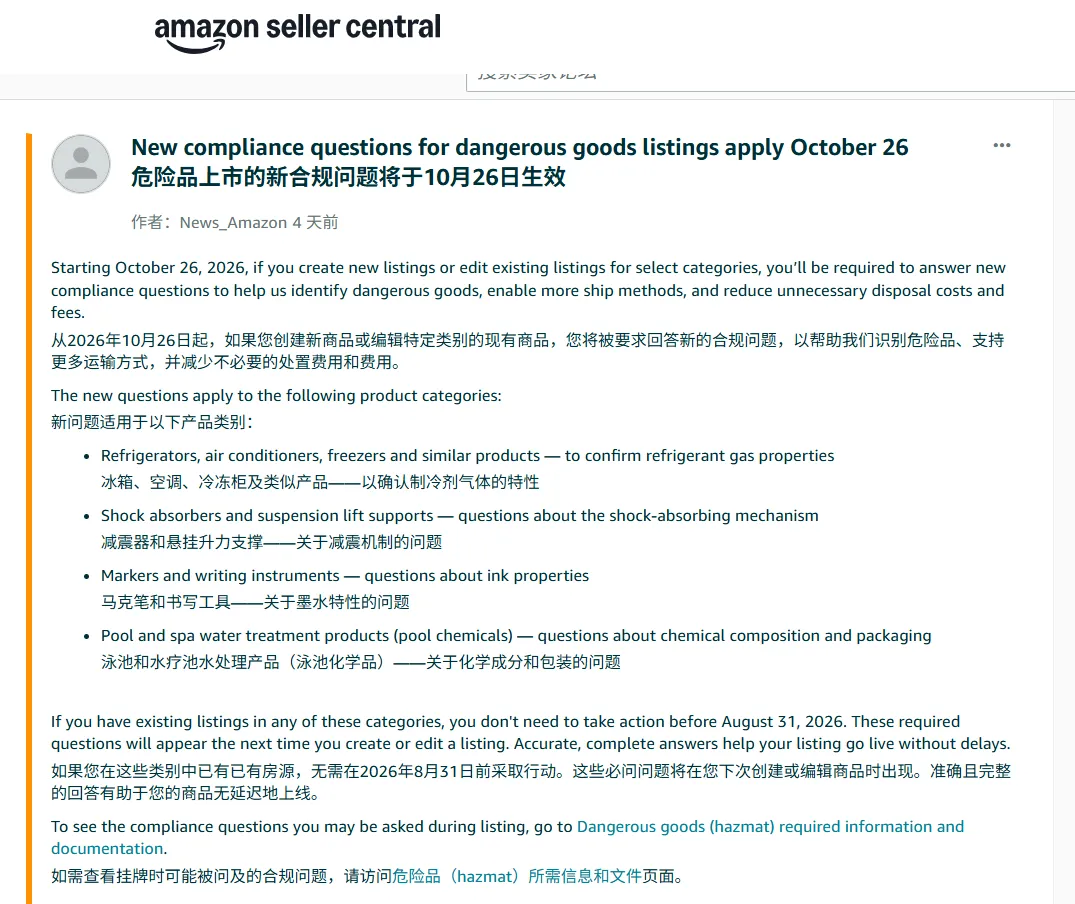
Simply put: before, you "might be inspected"; now, "everyone has to take the test."
1.2 Which situations trigger the questionnaire, and which do not?
Two situations that trigger the questionnaire:
- Situation One: Creating a brand-new product Listing—from scratch, the questionnaire automatically appears on the editing page when listing a new product.
- Situation Two: Any edit to an existing Listing—Changing the title, bullet points, product attributes, variation details, main image, secondary images, and so on will trigger it. This is easiest to overlook: many sellers routinely optimize their copy, only to have several Listings locked at the same time.
Situations that do not trigger it:
- Ordinary products (those that contain none of the sensitive attributes, such as batteries, liquids, powders, or chemical ingredients) may automatically skip the questionnaire after the system determines their classification
- You can check the system’s dangerous goods classification for your products in advance in the "Compliance Status Dashboard" in the backend
1.3 Which product categories are most likely to be "flagged"?
Many sellers have a misconception: they think only products containing lithium batteries are considered dangerous goods. In reality, Amazon’s dangerous goods coverage is much broader than you might expect:
- Products with batteries:Lithium batteries, button batteries, and electronic products with charging functions
- Liquids:Essential oils, perfumes, skincare products, cleaning fluids, ink, and beverage refills
- Powders:Protein powder, scented powder, chemical raw materials, and large packages of seasonings
- Pastes/gels:Ointments, hand creams, adhesives, and modeling clay
- Sprays/aerosols:Sunscreen sprays, setting sprays, air fresheners, and rust removers
- Products with chemical ingredients:Nail polish, nail polish remover, alcohol wipes, and battery fluid
If you sell products in categories such as beauty, personal care, household cleaning, 3C accessories, and outdoor supplies, you’re highly likely to be affected. We recommend checking the data in the compliance dashboard now—don’t wait until the pop-up appears to start scrambling.
II. Step-by-Step Guide to Completing Amazon’s Dangerous Goods Questionnaire
2.1 Where can you access the questionnaire?
You don’t need to look for a specific page. The questionnaire window will automatically pop up during the editing process on the Listing editing page when the system determines that a product may involve dangerous goods. After completing and submitting it, you can check the review status on the same editing page and in the backend compliance dashboard.
2.2 What information do you need to enter in the questionnaire?
The key information includes:
- Product ingredients and dangerous goods classification (flammable, corrosive, toxic, pressurized gas, and so on)
- UN number (United Nations number for dangerous goods; enter it if available, or select "Not applicable")
- Transport group (Packing Group I/II/III)
- Select the applicable attributes, such as whether the product contains a lithium battery or liquid
Depending on the category determined by the system, you may also be required to upload supporting documents. The most commonly requested document is the MSDS (Material Safety Data Sheet). Products containing batteries may require an additional transport assessment report related to lithium batteries.
2.3 How long does the review take?
There is no fixed turnaround time; it depends directly on how complete your documentation is:
- If your documents are complete, the classification is accurate, and the information is consistent: approval may come within a few hours to 1 business days;
- If there are inconsistencies, the wrong classification is selected, or the MSDS version is incorrect, your submission may be rejected. You will need to make corrections and resubmit, and back-and-forth delays of a week are common.
So don’t approach this with a “I’ll just fill it out any old way and see what happens” attitude. Each rejection means several more days of waiting, delaying your listing schedule.
2.4 Most common reasons for rejection—and how to avoid them
Based on extensive hands-on experience with Amazon, the Top 3 reasons for questionnaire rejection are:
(1) Questionnaire information does not match the certificate documents
For example, the MSDS states that the ingredient concentration is 70%, but you entered 90% in the questionnaire; the MSDS classifies it as “Class 3 flammable liquid,” but you selected “Class 8 corrosive substance” in the questionnaire. The system will catch such inconsistencies during its initial review.
(2) Understating the hazard level
Some sellers think that reporting a lower hazard level will make approval easier, so they deliberately classify products as ordinary goods. Amazon’s algorithm cross-checks your product category, keywords, images, and even the classifications of similar products in the same category. The likelihood of underreporting being detected is extremely high. If it is deemed a “misdeclaration,” the consequences are far more serious than a rejected review.
(3) MSDS report does not meet platform requirements
You can’t just use any MSDS you find. Amazon has requirements for the issuing organization, report version, and required information. Outdated MSDS reports, those issued by unrecognized organizations, or those missing key information will all be rejected.
2.5 Optimizing older Listings in bulk? Don’t do this
Many operations teams have a habit of optimizing Listings monthly or quarterly by changing titles and images or adjusting keywords. After the new rules take effect, do not edit a large number of existing Listings all at once. Every edit triggers a dangerous goods review. If hundreds of listings enter the review queue simultaneously, many of your store’s products may be locked and unavailable for sale, resulting in real financial losses.
The right approach: work in batches, optimizing 10-20 items per day, and monitor the approval rate and turnaround time. Proceed steadily and cautiously.
III. In-depth trend analysis: Why is Amazon tightening dangerous goods controls now?
Many people interpret these new rules as “Amazon stirring up trouble again,” but if you look at the longer-term timeline, you’ll see that this is just one part of the global trend toward stricter platform compliance.
3.1 The broader context: Dangerous goods regulations are tightening worldwide
International rules for the transport of dangerous goods (the United Nations Recommendations on the Transport of Dangerous Goods, or UN TDG) are updated every two years, and countries continue to strengthen their transport safety regulations. The aviation industry (IATA DGR) and maritime industry (IMDG Code) are imposing increasingly strict transport restrictions on lithium batteries, aerosols, and chemicals—multiple major markets updated their dangerous goods transport requirements in 2025-2026.
As one of the world’s largest e-commerce platforms, Amazon handles astronomical volumes of transportation and storage. If a safety incident involving dangerous goods occurs at one of its warehouses, the resulting fines and reputational damage would be beyond what the platform could bear.
3.2 The new European GPSR rules: the final straw
At the end of 2024, the EU General Product Safety Regulation (GPSR) officially took effect, significantly increasing platform responsibilities. Amazon must not only be responsible for products offered for sale, but also actively monitor for and identify unsafe products. Dangerous goods controls are a key area of focus under the GPSR compliance framework.
If you sell on Amazon’s European marketplaces, you should understand this context. To a large extent, the introduction of this questionnaire mechanism is Amazon’s way of shifting compliance requirements to sellers in order to meet EU regulatory requirements.
3.3 How might requirements tighten further in the future? Three likely directions
Based on Amazon’s past compliance measures, we predict the following steps are highly likely:
- Step one (already implemented): Require answers upfront when creating or editing a Listing—this is the new rule being introduced now;
- Step two (expected within 6-12 months): Conduct a comprehensive review of all existing Listings—regardless of whether you edit them, the system will proactively review their dangerous goods classifications and require additional documents;
- Step three (further down the road): Link the process to FBA inbound shipment reviews—if the dangerous goods classification does not meet requirements, inbound storage will be restricted. The issue will go beyond simply removing the Listing.
So don’t assume that “I’ll be fine as long as I don’t edit my Listings for now.” Preparing for compliance in advance is always less costly than responding after the fact.
IV. The Practical Impact of Amazon’s New Dangerous Goods Compliance Rules on Cross-Border E-Commerce Sellers
4.1 Impact on operational efficiency: Editing is slower, and listing schedules need to be adjusted
In the past, editing a Listing took just a few minutes. Now, every edit has to wait for review. Teams working on bestsellers should take particular note: operations can no longer follow the old “test quickly, iterate quickly” approach. Every edit needs to be carefully considered. Think it through before making changes, rather than changing them and then regretting it.
4.2 Cost impact: Compliance expenses need to be included in the budget
MSDS reports, transport appraisal reports, dangerous goods classification appraisal reports... These all cost money. An MSDS report is needed for each product category, with fees ranging from several hundred to several thousand. If you have many SKUs across a diverse range of categories, these compliance costs can rise significantly. It is advisable to consolidate product categories in advance so that products in the same category can share one report, rather than preparing a separate report for each SKU.
4.3 Account risks: Performance metrics, fund security, and selling privileges
Under Amazon’s dangerous goods regulations, penalties for misdeclaration or concealing dangerous goods attributes become progressively more severe:
- Initial level:A single product is delisted, and additional documentation is requested
- Intermediate level:Multiple products in the same category are delisted in bulk, inventory removal is restricted, and performance metrics are flagged red
- Advanced level:The violation is deemed serious, account funds are frozen, and selling privileges are restricted or even revoked
This is especially important for teams operating multiple stores: if one store runs into trouble, related stores may also be affected. This risk should be taken seriously.
V. Seller Response Guide: Build Your Ongoing Compliance Safeguards
5.1 Step One: Conduct a Comprehensive Audit of Existing Listings
Do this now: export all the SKUs in your store and classify them into three categories
- Category A: Clearly non-dangerous goods—Contains no sensitive attributes. The system will automatically skip it, so it generally requires little attention;
- Category B: Potential dangerous goods—May involve liquids, powders, products containing batteries, chemical ingredients, or similar items. Prepare the documents in advance so you know what to expect when editing;
- Category C: Strictly restricted dangerous goods—For example, high-concentration alcohol products and products with high-capacity lithium batteries. Pay particular attention to the site’s prohibitions and restrictions, and confirm whether they can be sold.
5.2 Step Two: Build Your Compliance Document Library
We recommend organizing it as follows:
- One MSDS report for each product category (check the validity period and the issuing organization’s qualifications)
- Store UN38.3 test summaries and transport appraisal reports for products containing batteries separately
- Use a consistent naming convention for all reports: “Product category-Report type-Issue date” to make them easy to find
- Keep backup copies in both paper and scanned form, with one copy in the cloud and one stored locally
5.3 Step Three: Routine Compliance Checklist
Spend 10 minutes each week on these tasks:
- Open the “Compliance Status Dashboard” in Seller Central and check for new notifications or warnings
- Review account performance notifications for any performance records related to dangerous goods
- Monitor the Seller Central announcement board and keep up with Amazon’s interpretations of new compliance rules and policy updates
- If you receive a notice that a questionnaire has been rejected, address it that same day. Do not delay.
With compliance, the biggest risk is “not knowing what you don’t know.” Many sellers only see the notification after their products have been delisted, missing the best window to appeal.
5.4 Step Four: Familiarize Yourself with the Appeal Process in Advance
If your product is actually classified as belonging to a restricted category and your Listing is delisted, do not repeatedly resubmit edits—that will only leave more records of violations. The correct approach is:
- First, check the dangerous goods prohibitions and restrictions for the relevant site to confirm whether your product can be sold
- If the product can indeed be sold and the only issue is incomplete documentation, submit the complete documents through the appeal channel specified by the platform
- If the product does belong to a restricted category, delist it without arguing or trying to force the issue
There is a right way to write an appeal letter and organize supporting documents. We recommend assigning one person on the team specifically to handle compliance matters. Not everyone needs to understand everything, but at least one person should have a clear grasp of it.
Whenever Amazon introduces new rules, two kinds of reactions tend to emerge among sellers: one is “Here they go again, making things difficult for us,” and the other is “Preparing early means taking the initiative early.”
Looking at the evolution of Amazon’s dangerous goods regulations, tighter compliance requirements are a long-term trend and will not stop just because you complain. This questionnaire mechanism is only the beginning; requirements will only become stricter, not more relaxed.
Rather than waiting until a pop-up appears right in front of you and then frantically searching for reports, spend an afternoon now checking what dangerous goods you have in your store, filling in any missing documents, and putting the necessary processes in place.
Compliance is not a cost; it is a competitive moat. While your competitors are still losing links over a single copy optimization, your store can keep generating orders steadily. This is undoubtedly a genuine competitive advantage.
Product link 1:Free cross-border e-commerce ERP registration portal
Product link 2:Claim 36000 orders for free with no requirements
Customer service 3:Free, real-time answers to your cross-border e-commerce ERP questions
*Disclaimer: Some text, images, and other materials on this site are sourced from the internet and are provided for communication and learning purposes only. If you believe any material infringes your rights, please contact us by private message, and we will promptly remove it. No organization or individual may reproduce, excerpt, adapt, or otherwise use content from this site without authorization.
Source: Original website · Read the original
Related Learning
Amazon ASIN: What It Is, How to Find It, and How Sellers Use It
Table of Contents What Is an ASIN? How Do ASINs Work in Amazon’s Product Catalog? How Can You Find a…

Amazon Plans to Acquire AI Startup Decart for 70 Hundred Million US Dollars
AMZ123 has learned that, according to a recent report by The Wall Street Journal, Amazon is in acqui…

Financing solutions for Amazon sellers
Financing solutions for Amazon sellers Financing solutions are crucial when it comes to scaling your…