 EN
Working Capital Explained for Growing UK Businesses

Working Capital Explained for Growing UK Businesses
Working capital measures the short term resources available to meet a business’s short term obligations. This guide explains how to calculate and manage working capital, why it matters for growth and how payment timing can affect UK businesses.

Table of contents

Payoneer Team
A business can be profitable on paper and still struggle to meet its day to day financial commitments.
The reason often comes down to timing. A company may have significant sales and outstanding invoices, but customers might not pay for 30, 60 or 90 days. Meanwhile, suppliers, taxes and other operating costs still need to be covered.
This is where working capital comes in.
Working capital provides a measure of a company’s ability to meet its short term obligations using its short term assets. For growing UK businesses, managing working capital becomes particularly important as transaction volumes increase, operations expand internationally and more money becomes tied up in inventory or accounts receivable.
According to the British Business Bank, working capital supports day to day business operations.
Quick answer: Working capital is the difference between a business’s current assets and current liabilities. It provides an indication of whether the business has sufficient short term resources to meet its short term financial obligations.
It is important because it helps a business meet its short term financial obligations and continue operating while waiting for revenue and customer payments to arrive.
A business may be growing successfully but still experience pressure on working capital if money is tied up in unpaid invoices, inventory or other current assets.
Effective working capital management can help businesses maintain operational continuity, manage periods of growth and respond more effectively when the timing of incoming and outgoing payments changes.
What is working capital in business?
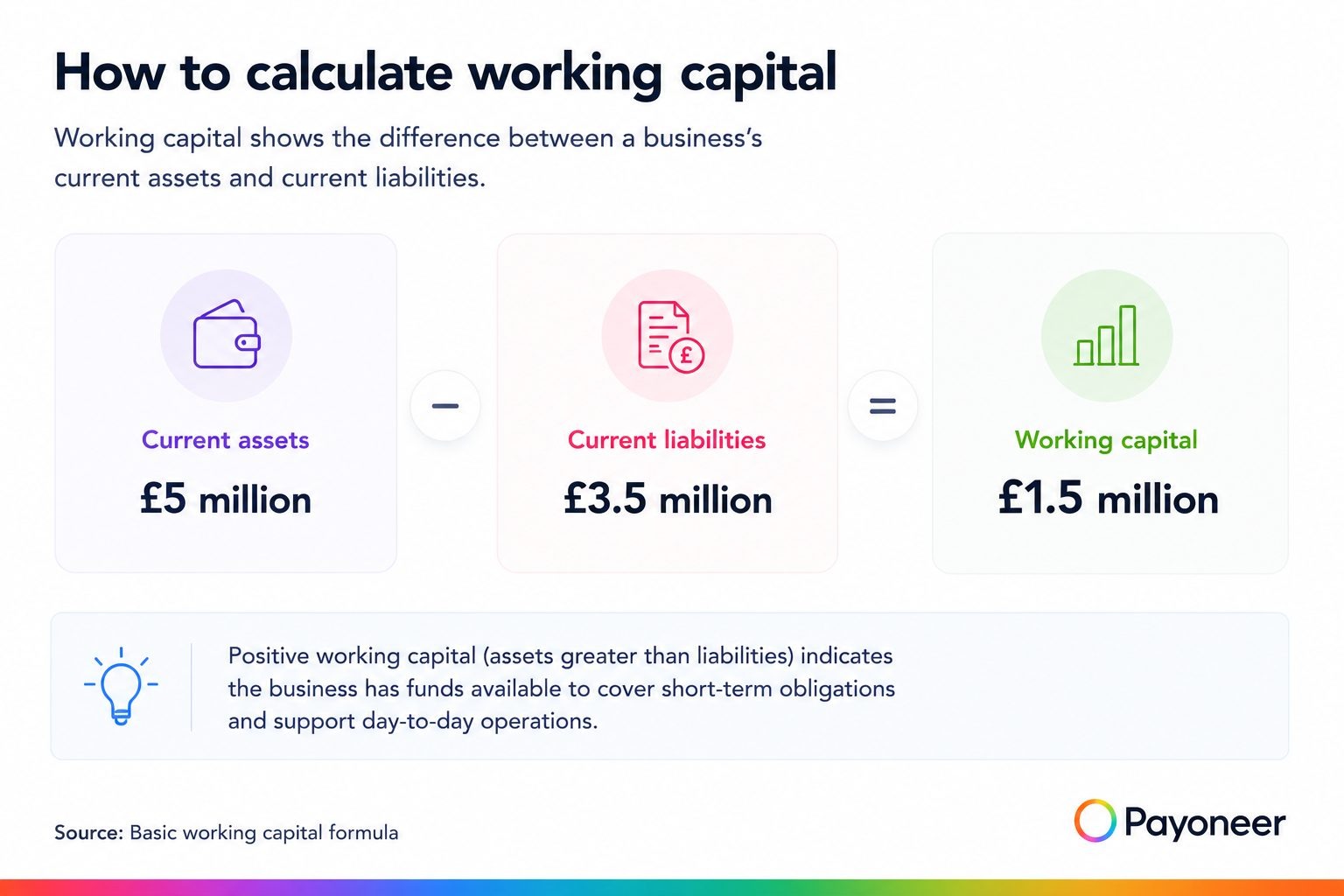
Working capital is generally calculated by comparing a company’s current assets with its current liabilities.
Working capital = Current assets − Current liabilities
Current assets typically include assets expected to be converted into cash within the short term, such as:
- Cash
- Accounts receivable
- Inventory
- Certain other short term assets
Current liabilities can include:
- Amounts owed to suppliers
- Taxes due
- Short term financial obligations
- Other liabilities due within the relevant period
Source: Payoneer
For example, imagine a business has:
Current assets: £5 million
Current liabilities: £3.5 million
Its working capital would be:
£5m − £3.5m = £1.5m working capital
A positive figure means current assets exceed current liabilities.
However, the number alone doesn’t tell the whole story.
A large proportion of current assets might consist of inventory that cannot be sold quickly or invoices that customers have not yet paid.
Businesses therefore need to understand both the amount and composition of their working capital.
Working capital vs cash flow: What’s the difference?
Working capital and cash flow are closely connected, but they are not the same thing.
Working capital compares current assets with current liabilities at a particular point in time.
Cash flow tracks money moving into and out of a business over a period.
| WORKING CAPITAL | CASH FLOW |
| Balance sheet measure | Tracks movement of money |
| Current assets minus current liabilities | Money coming in minus money going out |
| Indicates short term financial position | Shows timing of receipts and expenditure |
| Includes items such as receivables and inventory | Focuses on actual cash movements |
A company can therefore report positive working capital but still experience cash flow pressure.
For example, £2 million might be owed by customers, but if those invoices have not yet been paid, that money cannot necessarily be used to meet an obligation due today.
The UK Insolvency Service provides guidance for company directors on understanding and managing cash flow.
Why is working capital important for a business?
1. It supports day to day operations
Businesses have ongoing financial commitments regardless of when customers pay.
Working capital helps support normal operational expenditure and short term obligations.
This is why working capital shouldn’t be viewed only as an accounting metric. It directly relates to a company’s ability to operate.
2. It helps manage payment timing
B2B businesses frequently provide customers with payment terms.
An invoice may be issued today but not become payable for 30 or 60 days.
During that period, the business may still need to pay suppliers and meet other obligations.
This creates a potential working capital gap.
For more on improving the processes around incoming business payments, see Payoneer’s Get Paid by Clients resources.
Businesses should also consider how accounts receivable processes affect the time between issuing an invoice and receiving the corresponding payment.
3. Working capital can support growth
Growth can consume cash before it generates additional cash.
A business expanding into a new market may need to increase inventory, purchase services from additional suppliers or make other investments before the resulting customer payments arrive.
This creates an important principle:
Revenue growth and working capital requirements can increase together.
The faster a business grows, the more important it can become to understand when money is coming in and when financial commitments become due.
4. It can help businesses manage unexpected costs
Business costs don’t always follow forecasts.
Supplier prices can change, equipment can require replacement or an unexpected opportunity may require additional short term expenditure.
Appropriate working capital can give a business greater flexibility when circumstances change.
5. It can support seasonal businesses
Some businesses experience significant differences in demand throughout the year.
An eCommerce company, for example, might need to purchase inventory months before its busiest sales period.
The company therefore commits cash before it receives the corresponding customer revenue.
Understanding the working capital cycle can help finance teams plan for these periods.
What is the working capital cycle?
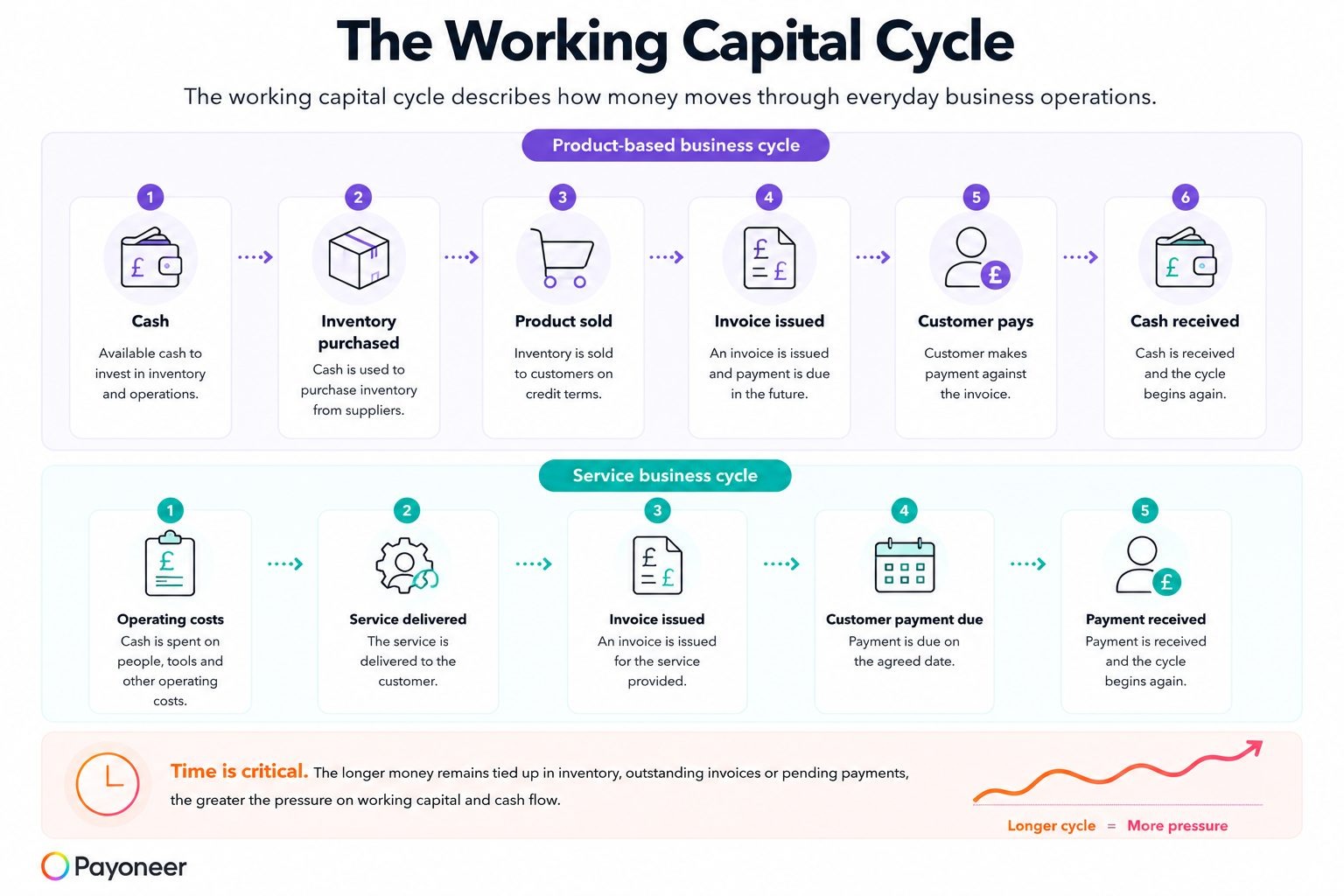
The working capital cycle describes how money moves through everyday business operations.
Source: Payoneer
A simplified product based cycle could look like:
Cash → Inventory purchased → Product sold → Invoice issued → Customer pays → Cash received
For a service business:
Operating costs → Service delivered → Invoice issued → Customer payment due → Payment received
The longer money remains tied up within the cycle, the greater the potential pressure on working capital.
Three areas are particularly important.
Accounts receivable
How long does it take customers to pay?
Longer payment periods can keep more money tied up in receivables.
Inventory
How long does stock remain unsold?
Excess inventory can represent substantial capital that isn’t readily available for other business requirements.
Accounts payable
When does the business need to pay suppliers?
The relationship between supplier payment terms and customer payment terms can materially affect working capital.
How can businesses improve working capital?
There isn’t one universal solution.
Businesses should identify where capital is becoming tied up within their own operations.
Improve accounts receivable
Reducing unnecessary delays between invoicing and payment can improve the working capital cycle.
Businesses can consider:
- Issuing invoices promptly
- Establishing clear payment terms
- Tracking outstanding invoices
- Sending appropriate reminders
- Resolving invoice disputes quickly
- Automating appropriate accounts receivable processes
- Improving reconciliation
Eligible businesses operating internationally can also review Payoneer’s Get Paid by Clients solutions for supported B2B payment requirements.
Review inventory management
Businesses holding physical stock should understand how quickly inventory is moving.
Purchasing significantly more stock than required can tie up capital unnecessarily.
However, reducing inventory too aggressively can create different operational problems.
The appropriate level depends on demand, supply chains and the business model.
Review supplier payment processes
Businesses should understand when supplier payments become due and incorporate those commitments into working capital forecasts.
The aim isn’t simply to delay payments. Maintaining appropriate supplier relationships and meeting agreed obligations remain important.
Instead, finance teams should understand the timing of outgoing payments alongside expected incoming payments.
Improve financial visibility
Larger organisations may have working capital distributed across different business units, markets and systems.
Finance teams need reliable information about:
- Receivables
- Payables
- Inventory
- Expected payments
- Upcoming obligations
- Transaction volumes
At a larger scale, connected treasury, ERP, accounting and payment systems can help finance teams gain a clearer picture of these different components.
What is working capital business finance?
Working capital finance refers to financing intended to support a company’s short term operational requirements.
Businesses may consider working capital finance when experiencing temporary cash flow gaps or when additional short term funding is required to support business activity.
Potential approaches vary considerably depending on the business, provider and circumstances.
The British Business Bank provides independent guidance on how working capital finance works and the options businesses may encounter.
Businesses considering finance should evaluate:
- Total cost
- Repayment requirements
- Eligibility
- Duration
- Impact on cash flow
- Business requirements
Professional financial advice may also be appropriate when evaluating financing options.
Working capital for international businesses
International expansion can make working capital management more complicated.
A UK company might:
- Invoice customers across several countries
- Receive payments involving different currencies
- Purchase inventory internationally
- Pay overseas suppliers
- Operate across several markets
- Experience different payment cycles by region
Timing becomes particularly important.
If suppliers need to be paid before international customer invoices are collected, additional working capital can become tied up in the operating cycle.
At larger transaction volumes, finance teams therefore need to consider the connection between working capital, accounts receivable, payments and treasury operations.
Payment infrastructure can become an important part of this wider financial operation.
Where does Payoneer fit?
Payoneer can support eligible businesses with aspects of international payment operations that sit within the wider working capital cycle.
For example, businesses operating internationally can review Payoneer’s solutions for receiving eligible B2B payments and making eligible commercial payments across supported markets.
Relevant Payoneer resources include:
- Get Paid by Clients for eligible B2B payment requirements
- Payoneer for Business for wider international business payment requirements
- Payoneer Mass Payouts for appropriate higher volume payout use cases
- Payoneer working capital resources for further information
- Payoneer Capital Advance for current information about availability and eligibility
Payoneer Capital Advance is subject to eligibility and availability. Businesses should review the applicable terms and current product information before deciding whether a particular solution meets their requirements.
For larger businesses, the wider opportunity is to connect international payment processes with accounts receivable, accounts payable and treasury operations so finance teams have better visibility across the working capital cycle.
Working capital checklist for growing businesses
Finance teams reviewing working capital can ask:
- What are our current assets and current liabilities?
- How much working capital do we currently have?
- How quickly do customers pay?
- How much money is tied up in accounts receivable?
- How much capital is tied up in inventory?
- When do supplier payments become due?
- Are payment terms creating working capital gaps?
- How does seasonality affect requirements?
- How could planned growth change our working capital needs?
- How much manual work exists across receivables and payments?
- Can finance teams see incoming and outgoing payment activity clearly?
- How do international operations affect payment timing?
The answers can help identify where improvements may have the greatest impact.
Manage working capital for growth, not just today
Working capital isn’t only an accounting metric. It reflects how financial resources move through a business and how effectively the organisation can meet its short term commitments.
For larger companies, working capital can become increasingly interconnected with accounts receivable, inventory, supplier payments, international transactions and treasury operations.
Growth can make these relationships more important because businesses often need to commit resources before additional revenue arrives.
The objective should therefore be to understand where capital is tied up, improve visibility across incoming and outgoing payments and build financial processes capable of supporting higher transaction volumes.
UK businesses can find further independent information through the British Business Bank and UK Government guidance for company directors.
Eligible businesses with international payment requirements can also review Payoneer for Business and Payoneer’s working capital resources as part of their wider approach to managing international business operations.
Frequently asked questions (FAQs)
Working capital is the difference between a company’s current assets and current liabilities. It indicates the short term resources available relative to short term obligations. The figure is useful, but businesses should also consider the composition of current assets, including how much is tied up in receivables or inventory.
Working capital is important because businesses need short term resources to meet obligations and continue operating while waiting for customer payments and other incoming cash. Effective working capital management can support day to day operations, periods of growth, seasonal changes and situations where the timing of incoming and outgoing payments creates pressure.
Working capital is generally calculated by subtracting current liabilities from current assets. If a company has £3 million of current assets and £2 million of current liabilities, its working capital is £1 million. Businesses should also consider whether assets such as receivables and inventory can be converted into cash when required.
No. Working capital is a balance sheet measure comparing current assets with current liabilities at a particular point in time. Cash flow tracks money moving into and out of a business over a period. A company can therefore have positive working capital while still experiencing cash flow pressure because of payment timing.
Working capital pressure can result from late customer payments, excessive inventory, unexpected expenditure, rapid growth, seasonal demand or a mismatch between customer and supplier payment terms. International expansion can add further complexity when businesses manage different payment cycles, currencies, suppliers and markets across the same operating period.
Businesses can review accounts receivable, inventory levels, supplier payment processes and financial forecasting. Prompt invoicing, clear payment terms, appropriate collections processes and better financial visibility may help reduce unnecessary delays. The appropriate approach depends on where capital is tied up and the operational requirements of the individual business.
Working capital finance refers to finance intended to support short term operational requirements, including temporary gaps between incoming and outgoing payments. Available approaches, costs, terms and eligibility vary by provider and business circumstances. Businesses should assess total cost, repayment requirements and cash flow impact, and obtain appropriate professional financial advice where needed.
Yes. International expansion can increase inventory, supplier and operating requirements before corresponding customer revenue is received. Different payment cycles, currencies and markets can also make payment timing more complex. As transaction volumes grow, finance teams may need clearer visibility across receivables, payables, treasury activity and international payment processes.
Related resources

How to Get Working Capital for Your Business in the UK
Working capital can come from stronger cash flow management or appropriate external finance. This guide explains how UK businesses can identify funding gaps, compare financing options and assess the costs…

Payoneer Team

한국 틱톡 크리에이터의 성장: 국내 시장과 새로운 기회
한국의 크리에이터 생태계는 세계에서 가장 역동적인 시장 중 하나로 성장하고 있습니다. 무엇이 이러한 성장을 이끌고 있을까요? 그리고 틱톡은 왜 한국 크리에이터에게 중요한 플랫폼이 되었을까요?
Payoneer Team

The Marketplace Swing: Why Retailers Are Going 3P and What It Takes to Win
Retailers are shifting from 1P to 3P marketplaces to expand assortment, improve margins, and unlock new revenue. Here’s what’s driving the marketplace swing and what it takes to scale.
Payoneer Team

Can Businesses Offshore Without Losing Connection to Their Teams?
How Christopher Fellas changed Insight Management Partners’ offshoring model by removing management layers, owning staff relationships and using AI well.
Payoneer Team

Why Do Corporate Service Providers Need More Than Incorporation?
Why CSP networks matter: CSPN co-founders discuss trust, referrals, compliance, AI adoption and how service providers can support business growth today.
Payoneer Team

Digital Payment Solutions in Pakistan: Apps, Use Cases and Choosing the Right One
Discover digital payment solutions in Pakistan, including popular apps, use cases, and how to choose the right option for local and international payments.
Payoneer Team

Can AI Help Businesses Scale Without Scaling Complexity?
Ben Stein of Staple discusses AI, automation, compliance, ROI, and how businesses can scale operations without adding complexity at the same pace today.
Payoneer Team

What Has to Be Ready Before Cross-Border Growth Gets Complicated?
Nagesh Devata and Eldred Wee discuss how SMEs can prepare financial infrastructure, payments and corporate services for cross-border growth from day one.
Payoneer Team

The Growth Ceiling Is Usually Cash Flow — Here’s How to Raise It
Cash flow can become a growth ceiling for ecommerce sellers. Learn how working capital and payment infrastructure can help businesses manage inventory, seize opportunities, and scale.
Payoneer Team
Latest articles
-

Best EOR providers in Germany: the AÜG-licensed route [2026]
Compare six compliant hiring providers in Germany on pricing, AÜG permit status, verified German entities, and 2026 employer costs.
-

Best EOR services in Serbia: Why a licensed agency is the legal route [2026]
Hire compliantly in Serbia without a local entity. Compare six workforce providers on licensing, verified Serbian entities, and employer costs.
-

Best EOR providers in Croatia: the registered agency route [2026]
Hire in Croatia without a local entity. Compare six providers on ministry registration, assignment limits, equal pay duties, pricing, and what each one omits.
-

Seven best EOR service providers in Belgium for 2026
Compared seven EOR service providers for Belgium, where sectoral joint committees set real wages, holiday pay comes twice, and notice periods can stretch past half a year.
-

Best EOR providers in Poland for 2026: Pricing, coverage, and local fit compared
Hiring in Poland means strict contracts, tax deadlines, and labor audits. Compare 5 EOR providers on price, setup, and compliance to find the right fit.
-

Best EOR providers in Costa Rica for 2026
Hiring in Costa Rica means navigating strict CCSS rules, wage hikes, and severance laws. Compare 5 EOR providers for 2026 to hire compliantly without risk.
Disclaimer
The information in this article/on this page is intended for marketing and informational purposes only and does not constitute legal, financial, tax, or professional advice in any context. Payoneer and Payoneer Workforce Management are not liable for the accuracy, completeness or reliability of the information provided herein. Any opinions expressed are those of the individual author and may not reflect the views of Payoneer or Payoneer Workforce Management. All representations and warranties regarding the information presented are disclaimed. The information in this article/on this page reflects the details available at the time of publication. For the most up-to-date information, please consult a Payoneer and/or Payoneer Workforce Management representative or account executive.
Availability of cards and other products is subject to customer’s eligibility. Not all products are available in all jurisdictions in the same manner. Nothing herein should be understood as solicitation outside the jurisdiction where Payoneer Inc. or its affiliates is licensed to engage in payment services, unless permitted by applicable laws. Depending on or your eligibility, you may be offered the Corporate Purchasing Mastercard, issued by First Century Bank, N.A., under a license by Mastercard® and provided to you by Payoneer Inc., or the Payoneer Business Premium Debit Mastercard®, issued and provided from Ireland by Payoneer Europe Limited under a license by Mastercard®.
Skuad Pte Limited (a Payoneer group company) and its affiliates & subsidiaries provide EOR, AOR, and contractor management services.
Source: Payoneer Team ·Read original
Related Learning
International Import Shipping: 2026 Tariff Guide
Update on tariffs and international trade U.S. tariffs changed on February 20, 2026. Here’s what you…

Taxable Invoice Guide: How to Create a Compliant Tax Invoice for International Clients
Taxable Invoice Guide: How to Create a Compliant Tax Invoice for International Clients From taxable …

How to Confirm Requirements When a Customer Sends Drawings and Technical Requirements
After receiving customer drawings, foreign trade staff need to check file revisions, dimensions, mat…