 EN
Get Your Invoices Paid Faster: 5 Research-Backed Hacks You Should Use

Get Your Invoices Paid Faster: 5 Research-Backed Hacks You Should Use
Get your invoices paid faster with 5 research-backed strategies. Learn how to adjust payment terms, automate reminders, and improve cash flow for your business.

Table of Contents

Payoneer Team
Editor’s note: This is a guest post by Bamidele Onibalusi, freelance writer and Founder at Writers in Charge.
Late invoice payments are no fun. They force freelancers and small business owners to get creative with their bills, instead of their work. Yet, severe cash shortfalls are a sad reality for lots of entrepreneurs. A recent survey of UK SMEs revealed that:
- 51% of respondents state that late payments became a bigger problem than it was 3 years ago
- 58% state that late payments put their business on the verge of failure
- 51% of small business owners are also forced to dip into their personal savings to cover deficiencies
In the freelance economy, late invoice payments are also rampant. Bonsai estimated that 29% of freelance invoices are paid after the due date. The bigger problem, however, is that late payments often evolve into non-payments – another issue plaguing the freelance space. A PayPal study indicates that half of US freelancers have experienced not being paid at least once.
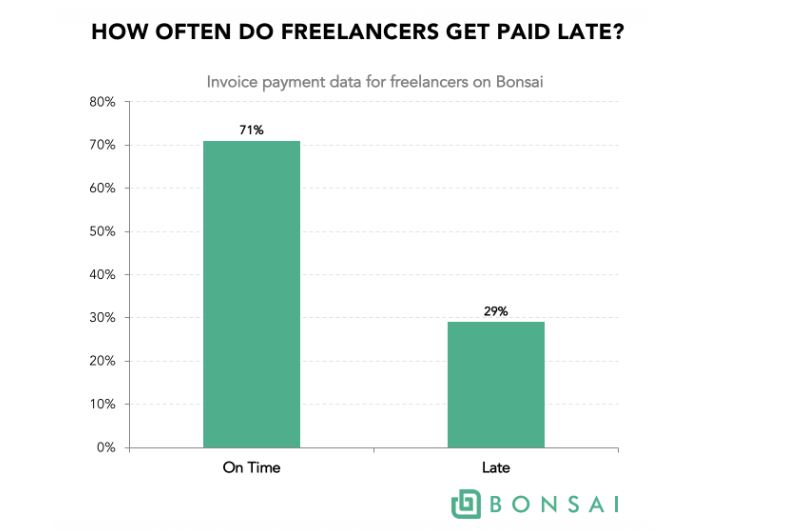 Source: Bonsai
While new legal mechanisms emerged to protect freelancers against non-payment, chasing up a single paycheck still takes a lot of productive time. That is unless you approach your invoicing process the smart way.
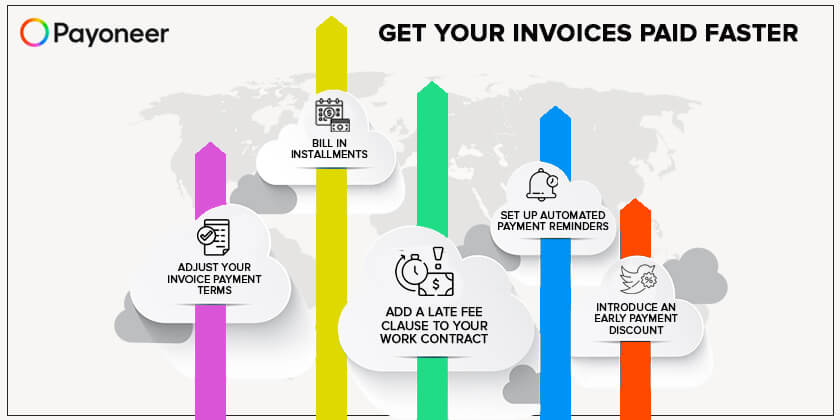
Below are several data-backed strategies that will help you get your invoices paid faster.
1. Adjust Your Invoice Payment Terms
What’s the most important number in your invoice? Nope, it’s not the grand total. It’s the due date!
A due date stipulates when your client is contractually obliged to settle your invoice. Forgetting to set a date in stone can result in misunderstandings. For instance, your client may assume that it’s alright to pay you in two months when you hoped to get that paycheck in two weeks.
Here are some ways to avoid such scenarios:
- Communicate your standard payment terms to every client before you begin work
- List the due date and the payment terms on your invoice
Which payment term should you use? Let’s take a look at your options:
Due Upon Receipt
Such invoices should be paid by the end of the business day. Failure to do so will count as a contract breach and enable you to pursue further action (e.g. charge late fees).
While this payment term is advantageous for freelancers as they recuperate their cash faster, it’s somewhat problematic for their B2B clients. Larger companies often have complex billing cycles and your invoice needs to pass several approval stages before it can be settled. Thus, in most cases, it cannot be paid the same day. This may create unwanted tension between you and your client.
Also, ‘due upon receipt’ is not the best option for large projects (e.g. website development, marketing strategy consulting or video production) where the client will need time to review all the deliverables, and double-check those. This payment term works best for small scale, one-off jobs such as photo retouching, social media copy creation or 2-page translation work.
Net D Payment Term
D stands for the number of days you give the client to settle your invoice. The most common time frames are as follows:
- Net 7 – payment due within seven days
- Net 14 – payment due within two weeks
- Net 30 – payment due within a month
- Net monthly – payment should be made at the end of the month following invoice due date. For example, if you send your invoice on October 21st, your client will have to pay it by November 30th at the latest.
So how long should you give your client to pay? Xero’s study suggests that invoices with shorter payment terms are paid faster. So, opt for NET 7 or NET 14 if you want to receive your payment the same month:
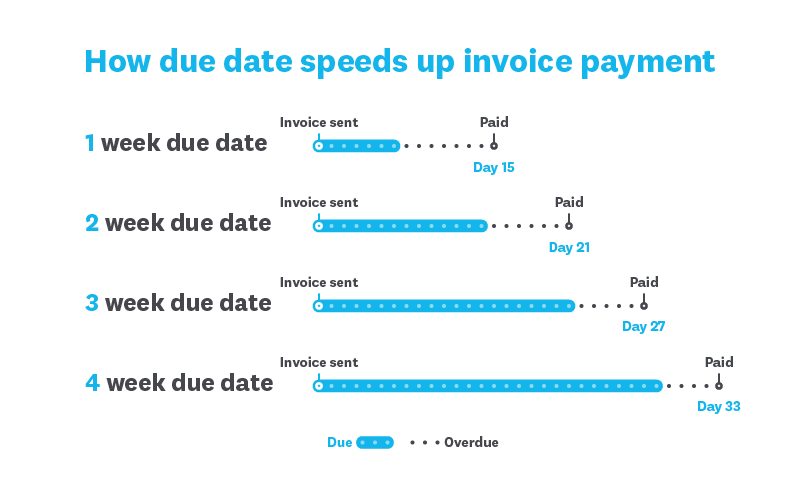 Source: Xero
2. Add a Late Fee Clause to Your Work Contract
As Xero’s graph illustrates, clients will often miss due dates and ignore the payment terms. Collecting those overdue payments can turn into a months’ long struggle, eating up a good chunk of your productive time.
To save yourself the energy, consider adding a late fee clause to your work contract. It could be a simple one-liner stating that:
“Any overdue payments shall require the client to pay a non-compounding X% late fee, accrued monthly on the outstanding amount.”
The standard late fee is 1%-5% max. You can also choose to charge a fixed late fee (e.g. $100 per invoice), though this is less common. In any case, be sure to bring up this clause to your client’s attention as they sign the work contract and remind them about it when you send over your invoice.
Late fees can create dissatisfaction among some clients, but they do help you receive your money faster.
3. Bill in Installments
Another proven method for getting your invoices paid faster is breaking down large project payments into more manageable installments.
Bonsai research shows that invoices totaling $1,000 or less are settled faster:
That makes sense for several reasons:
- Smaller companies may experience cash flow issues of their own so it may be difficult for them to shell out large sums quickly
- Larger businesses forward the big invoices to their accounting or procurement department that is dealing with hundreds of payments per month which makes the settlement process slower
Want to speed things up? First of all, you approach the client and offer them a custom payment plan – an arrangement that works best for both of you. You can offer to time your invoices to their payroll schedule, for instance. Or, set up a recurring monthly billing plan like a lot of hosting providers do, and collect cash automatically. Perhaps ask your client to speak to their accountant and work things out with them directly.
Bill your clients digitally and offer several payment methods (debit/credit card, bank transfer, etc.). Always re-check your payment details before hitting send.
Lastly, make sure that:
- Your invoice always goes to the right person (e.g. the accountant)
- You have an alternative point of contact in the company and can escalate the late payment issue to someone above your direct manager
If your payment is severely overdue, contacting a senior person may be the best way to draw more attention to the problem and solicit faster resolution.
4. Set Up Automated Payment Reminders
No freelancer likes to appear demanding or impatient when it comes to getting paid. Sometimes firm and polite payment reminders are a necessary evil.
After all, things fall through the cracks all the time, and without a gentle nudge, your invoice can remain buried within a mounting pile of ‘will do late’ chores. So it’s best to remain proactive and create an automated email sequence of payment reminders for clients who tend to miss the due dates.
Your collection should include:
- A payment reminder before the due date – mention that the invoice you’ve sent is approaching its due date and should be settled in X days. Failure to do so can result in late fees.
- First overdue payment reminder – If no action happened on the client-side for 5 business days, dispatch another reminder. Be firmer this time, and state that late fees now apply.
- Second overdue payment reminder – Still crickets? Well, it’s time to be even more direct and state that you plan to escalate the issue to a senior person within the organization or pursue legal action.
Most invoicing software now lets you auto-schedule payment reminders for each overdue invoice. Alternatively, you can use Boomerang for Gmail to do the same.
5. Introduce an Early Payment Discount (with a caveat)
Early payment discounts (also called settlement discounts) are common for five-figure invoices that tend to get stuck in the billing pipeline. It’s a good method for injecting more cash into your business when you have several large invoices due at once and want to avoid cash shortfalls.
Most settlement discounts are as low as 1%-2% of the total invoice and are granted to customers who pay the invoice within 10 or 15 days of receipt. Such terms are added to the invoice as:
- 1/10 – net 30
- 2/10 – net 30
- 1/15 – net 30
We all know that discounts are tricky, and customers may start questioning your pricing and bargain with you the next time around. So here’s one research-backed hack to avoid this – pair your discount with a quick favor request.
A study conducted by The Georgetown University McDonough School of Business showed that favor request majorly increases acceptance of discounted offers. Most people view a discount as a ploy to sell a product. They think that everyone else is receiving the same treatment, thus the offer loses its value (and so do you as a seller).However, when you ask a customer to provide a quick favor in exchange for that discount, they start viewing it as a personalized offer and less of a ploy. The negotiation processes stops being a competition and turns into a reciprocal interaction (i.e. both of us will get something out of this deal).
So if you plan to pitch an early payment discount, pack it along with a quick favor request. For instance, ask the client to provide a referral, leave a review on your LinkedIn/website or write up a testimonial.
Your Business Bottom Line is Important
A business that struggles with cash flow ultimately becomes too expensive to maintain. Stop leaving money on the table and take proactive action when it comes to your invoices!
Bamidele Onibalusi is a successful freelance writer and the founder of Writers in Charge, a leading writing website that helps people get paid to write. You can also follow him on Twitter: @youngprepro.
Related resources

Payment Apps for Small Businesses: A Guide for UK Businesses
Payment apps for small businesses can provide convenient access to payment functionality, but the wider platform becomes more important as payment needs grow. This guide explains what UK businesses should…

Payoneer Team

Best Payment Gateways for Small Businesses in the UK
Choosing the right payment gateway means finding a solution that fits your website, customers, budget and payment requirements. This guide covers the key factors UK small businesses should compare, including…
Payoneer Team

Payment Gateways Explained for UK Businesses
Payment gateways play a key role in online transactions by helping transmit payment information between customers, businesses and payment systems. This guide explains how they work, how they differ from…
Payoneer Team

Safest Ways to Make and Receive Payments Online
Whether you're paying a contractor, invoicing an international client or selling products and services online, choosing an appropriate payment method can help protect your business and make transactions easier to…
Payoneer Team

How to Accept Online Payments for Your Business in the UK
For UK businesses selling products or services online, giving customers a convenient way to pay is an important part of creating a smooth purchasing experience. Whether you run an eCommerce…
Payoneer Team

Working Capital Explained for Growing UK Businesses
Working capital measures the short term resources available to meet a business's short term obligations. This guide explains how to calculate and manage working capital, why it matters for growth…
Payoneer Team

How to Get Working Capital for Your Business in the UK
Working capital can come from stronger cash flow management or appropriate external finance. This guide explains how UK businesses can identify funding gaps, compare financing options and assess the costs…
Payoneer Team

한국 틱톡 크리에이터의 성장: 국내 시장과 새로운 기회
한국의 크리에이터 생태계는 세계에서 가장 역동적인 시장 중 하나로 성장하고 있습니다. 무엇이 이러한 성장을 이끌고 있을까요? 그리고 틱톡은 왜 한국 크리에이터에게 중요한 플랫폼이 되었을까요?
Payoneer Team

The Marketplace Swing: Why Retailers Are Going 3P and What It Takes to Win
Retailers are shifting from 1P to 3P marketplaces to expand assortment, improve margins, and unlock new revenue. Here’s what’s driving the marketplace swing and what it takes to scale.
Payoneer Team
Latest articles
-

Best EOR providers in Germany: the AÜG-licensed route [2026]
Compare six compliant hiring providers in Germany on pricing, AÜG permit status, verified German entities, and 2026 employer costs.
-

Best EOR services in Serbia: Why a licensed agency is the legal route [2026]
Hire compliantly in Serbia without a local entity. Compare six workforce providers on licensing, verified Serbian entities, and employer costs.
-

Best EOR providers in Croatia: the registered agency route [2026]
Hire in Croatia without a local entity. Compare six providers on ministry registration, assignment limits, equal pay duties, pricing, and what each one omits.
-

Seven best EOR service providers in Belgium for 2026
Compared seven EOR service providers for Belgium, where sectoral joint committees set real wages, holiday pay comes twice, and notice periods can stretch past half a year.
-

Best EOR providers in Poland for 2026: Pricing, coverage, and local fit compared
Hiring in Poland means strict contracts, tax deadlines, and labor audits. Compare 5 EOR providers on price, setup, and compliance to find the right fit.
-

Best EOR providers in Costa Rica for 2026
Hiring in Costa Rica means navigating strict CCSS rules, wage hikes, and severance laws. Compare 5 EOR providers for 2026 to hire compliantly without risk.
Disclaimer
The information in this article/on this page is intended for marketing and informational purposes only and does not constitute legal, financial, tax, or professional advice in any context. Payoneer and Payoneer Workforce Management are not liable for the accuracy, completeness or reliability of the information provided herein. Any opinions expressed are those of the individual author and may not reflect the views of Payoneer or Payoneer Workforce Management. All representations and warranties regarding the information presented are disclaimed. The information in this article/on this page reflects the details available at the time of publication. For the most up-to-date information, please consult a Payoneer and/or Payoneer Workforce Management representative or account executive.
Availability of cards and other products is subject to customer’s eligibility. Not all products are available in all jurisdictions in the same manner. Nothing herein should be understood as solicitation outside the jurisdiction where Payoneer Inc. or its affiliates is licensed to engage in payment services, unless permitted by applicable laws. Depending on or your eligibility, you may be offered the Corporate Purchasing Mastercard, issued by First Century Bank, N.A., under a license by Mastercard® and provided to you by Payoneer Inc., or the Payoneer Business Premium Debit Mastercard®, issued and provided from Ireland by Payoneer Europe Limited under a license by Mastercard®.
Skuad Pte Limited (a Payoneer group company) and its affiliates & subsidiaries provide EOR, AOR, and contractor management services.
Source: Payoneer Team ·Read original
Related Learning

How to Confirm Requirements When a Customer Sends Drawings and Technical Requirements
After receiving customer drawings, foreign trade staff need to check file revisions, dimensions, mat…
International Import Shipping: 2026 Tariff Guide
Update on tariffs and international trade U.S. tariffs changed on February 20, 2026. Here’s what you…

How Should You Follow Up When a Customer Does Not Reply to a Quotation?
A customer’s temporary lack of response after receiving a quotation does not necessarily mean they h…