 EN
How Should You Price Products on Shopee? A Breakdown of the Latest Pricing Logic for 2026 (Including Detailed Guides for Different Markets)

Many Shopee sellers encounter a common problem: their stores seem to receive orders steadily, but when they calculate profits at the end of the month, they discover that they are barely making money—or even losing more as they sell more. Ultimately, this is usually because they have not fully understood Shopee's pricing logic. They simply apply markups based on experience, overlooking key factors such as fee differences across markets, hidden costs, and category characteristics.


To price Shopee products effectively and escape destructive low-price competition and loss-making orders, sellers cannot apply a single pricing template. Drawing on practical operating rules for markets in Southeast Asia and Brazil, this article breaks down the underlying logic of Shopee product pricing, end-to-end costs, and pricing strategies by market and category. It also compiles common pitfalls sellers encounter and provides implementation solutions using professional tools to help cross-border sellers price accurately and achieve stable profitability.


🎁🎁Tools for Efficient Shopee Operations:Use for 0 yuan and receive 3 ten-thousand orders


One. Shopee Pricing Logic: Understand the Cost Structure Before Setting the Selling Price


Unlike other cross-border platforms, Shopee has a distinctive dual-price system combining a front-end listed price with a back-end hidden price component. This is also a key reason many new sellers lose money through their pricing. The true core logic of Shopee pricing is far more than simply adding a markup to procurement costs. It requires the selling price to fully cover explicit costs, hidden costs, and platform deductions, while leaving a buffer for promotional discounts, exchange-rate fluctuations, and returns-related product losses. This is the fundamental principle underlying Shopee product pricing.


Many sellers calculate only readily apparent costs such as procurement and logistics, overlooking hidden platform deductions and loss-related costs, which ultimately leads to severely distorted profit calculations. The complete end-to-end costs involved in Shopee pricing fall mainly into three categories:

- Explicit Costs:Product procurement costs, packaging material costs, and domestic shipping costs to consolidation warehouses are the basic costs sellers can most easily track
- Fixed Platform Costs: Store commissions, transaction fees, FSS/CCB campaign service fees during major sales events, and allocated daily advertising expenses. Basic deductions apply across all markets, and fee rates vary greatly between markets
- Hidden Loss-Related Costs:Cross-border hidden price differentials, losses from international exchange-rate fluctuations, order returns and lost parcels, and allowances for product damage and inventory losses are also the cost items most easily overlooked and most likely to cause losses
Drawing on practical operating experience, here are two Shopee pricing formulas that can be applied directly to different scenarios, including listing new products and adjusting prices for existing products:
- Forward Additive Pricing (Suitable for Precise Cost Calculations): Selling Price = (Procurement + Packaging + Domestic Shipping + Cross-Border Hidden Price Component) ÷ (1 - Commission - Transaction Fee - Campaign Fee Rate) + Allocated Advertising Expenses + Planned Profit
- Reverse Calculation Pricing (Suitable for Target-Profit Pricing): Target Selling Price = Total Cost : (1 - Target Gross Margin)
Important Reminder: Commission rates, hidden pricing rules, and logistics fee schedules differ completely across Shopee markets. Copying the same price for the same product will very likely result in profits in some markets and losses in others. Targeted, differentiated pricing is essential.
Two. How to Price Products on Shopee: Pricing Strategies for Different Scenarios, Markets, and Categories
Shopee covers multiple countries in Southeast Asia as well as Brazil. Purchasing power, the intensity of market competition, logistics costs and taxes, and platform rules differ dramatically across regions. Operating models and profit potential also differ clearly between categories.
A generic pricing approach cannot accommodate operations across all markets. To help sellers implement Shopee product pricing accurately, the following section compiles more granular market- and category-specific Shopee pricing data from across the web, including mainstream categories in each market, benchmark gross-margin pricing rules, and key pitfalls to avoid. Sellers can refer to it directly.
2.1 Comparison of Category Characteristics and Recommended Gross Margins Across Shopee Markets
| Market | Mainstream Categories | Market Characteristics | Recommended Gross Margin |
| Malaysia | Small Household Items, Accessories, 3C Accessories | Mature market, predominantly small and medium-sized orders, a well-developed platform hidden pricing system, and stable traffic | 18%-28% |
| Philippines | Mother and Baby Products, Beauty Products, Home Storage | Highly price-sensitive users, relatively low overall average order value, and logistics costs accounting for an extremely high proportion | 22%-30% |
| Singapore | Beauty Products, Home Goods, Small Appliances | Strong purchasing power, high average order value, substantial demand for mid- to high-end products, and intense platform competition | 25%-35% |
| Thailand | Apparel, shoes and bags, jewelry | A large base of local sellers, intense low-price competition, and deep discounts during major promotions | 20%-28% |
| Vietnam | Daily necessities, small accessories | An extremely low-price market where users focus solely on price and sales volume is the primary business model | 15%-22% |
| Brazil | Household tools, outdoor supplies | High average order value, extremely high cross-border tariffs and logistics costs, and strict compliance requirements | 30%-45% |
2.2 Shopee Market-Specific Pricing Strategies and Key Pitfalls to Avoid
| Market | Key Pricing Strategies | Market-Specific Pitfalls |
| Malaysia | Moderately lower the displayed selling prices of traffic-driving products to attract traffic, and use the hidden-price mechanism for profit-generating products to improve overall profit. Leave approximately 15% room for discounts when listing products for regular sales to accommodate major platform promotions. | CCB deductions are relatively high in the Malaysian market. Calculating profit based solely on the displayed selling price can seriously distort the results and easily lead to hidden losses. |
| Philippines | Prioritize small, lightweight products and strictly control product weight to reduce logistics costs. The gross margin floor for the store's traffic-driving products must not fall below 20%. Do not pursue sales volume at a loss. | Last-mile logistics in the Philippines are expensive. Even a slight excess in product weight can cause costs to surge, so pricing must include a buffer for differences between weight brackets. |
| Singapore | Focus on quality premiums and differentiated products, avoid low-end price wars, and leverage high average order values to improve profit. Prioritize profit-generating and premium products. | Platform commissions in Singapore are higher than in other Southeast Asian markets, leaving no profit room for low-priced products. Consumers also have very low trust in extremely cheap goods. |
| Thailand | List new products in small batches to test pricing, monitor price changes among local competitors, and adjust selling prices flexibly. Reserve room for major promotional discounts in advance to align with the platform's marketing schedule. | Thailand's currency exchange rate fluctuates frequently and substantially. Pricing must include a sufficient exchange-rate buffer to avoid reduced proceeds. |
| Vietnam | Focus on low-cost daily necessities and small accessories, prioritize sales volume, strictly minimize procurement costs, and keep the gross margin floor for traffic-driving products above 15%. | Users in the Vietnamese market have a relatively high return rate. Pricing must account for product damage and return costs in advance to avoid after-sales losses. |
| Brazil | Abandon the low-price traffic-driving model and focus on high-gross-margin tools and outdoor categories. Pricing must account for compliance costs such as NF-e invoices and tariffs to protect profit margins. | Brazil's cross-border tax and fee rules are complex, and costs are extremely high. Omitting any tax, fee, or compliance cost can directly result in a loss on the entire order. |
Use the data in the tables above to support pricing operations across all store scenarios:
- Cold-Start Pricing for New Products:Refer to the benchmark gross margin for the relevant market and first research competitors' price ranges. Accurately distinguish whether competing products are loss-making traffic drivers or regular profit-generating products. Never blindly match the lowest price when listing products.
- Tiered Store Pricing:Keep traffic-driving products above the market's minimum gross margin floor to stimulate store traffic. Apply mid-range or high-end gross margins to profit-generating products to safeguard the store's core earnings. Use differentiated premiums for image-building products to elevate the store's overall positioning.
- Pricing for Major Promotions:Plan discount levels in advance and leave room for promotions in regular pricing. Strictly avoid the prohibited practice of temporarily changing the original price before applying a discount.
- Responding to Competitors' Price Adjustments:When faced with intense price competition, prioritize improvements to product details, service, and delivery speed to create differentiation. Do not blindly follow price cuts, and protect the store's profit floor.
Note: The rates above are for reference only. For actual pricing, use the data currently displayed in Seller Centre and the official pricing simulator.
Three: Checklist of Common Shopee Product Pricing Pitfalls
Based on numerous practical cases involving cross-border sellers, most pricing losses, store violations, and declines in ranking weight stem from a few recurring misconceptions. Avoiding these common pitfalls is more important than blindly optimizing pricing formulas.
- Blindly Copying Competitors' Selling Prices:Many sellers directly copy competitors' displayed prices while ignoring their hidden-price settings, supply chain costs, and loss-making traffic-driving strategies. They ultimately find themselves in a situation where "others profit from orders, while they lose money on theirs."
- Incomplete Cost Accounting:Counting only procurement and first-leg logistics costs while completely ignoring hidden costs such as CCB campaign deductions, platform commissions, exchange-rate losses, and damage to returned goods means that the higher the order volume, the greater the overall losses.
- Uniform Pricing Across All Markets:Ignoring differences in logistics, taxes and fees, commissions, and purchasing power across markets and applying one set of prices to all markets leads to prolonged, unproductive losses in some markets.
- Noncompliant Pricing with Fake Discounts:Temporarily raising a product's original price just before a major promotion and then applying a large discount violates Shopee's rules against fake discounts, resulting in product delisting, store penalty points, and reduced ranking weight.
- Frequent, Substantial Price Adjustments:Repeatedly making substantial changes to product selling prices and promotional prices within a short period can seriously damage Listing ranking weight, reduce platform traffic support, and directly affect exposure and conversion rates.
- Ignoring exchange rate fluctuation risks:Exchange rates fluctuate frequently across Southeast Asian marketplaces. If pricing leaves no buffer, exchange rate differences can directly eat into profits once payments are received, turning an apparent profit into an actual loss.
Four. How can sellers operate efficiently after pricing their Shopee products?
Product pricing is only the starting point of Shopee operations. Profit calculation, advertising, and traffic expansion after pricing determine whether the business can ultimately generate real profits. Saihu ERP has developed end-to-end operational tools for Shopee sellers' post-pricing workflows, covering profit calculation, advertising, and affiliate marketing to help sellers put their pricing strategies into practice.
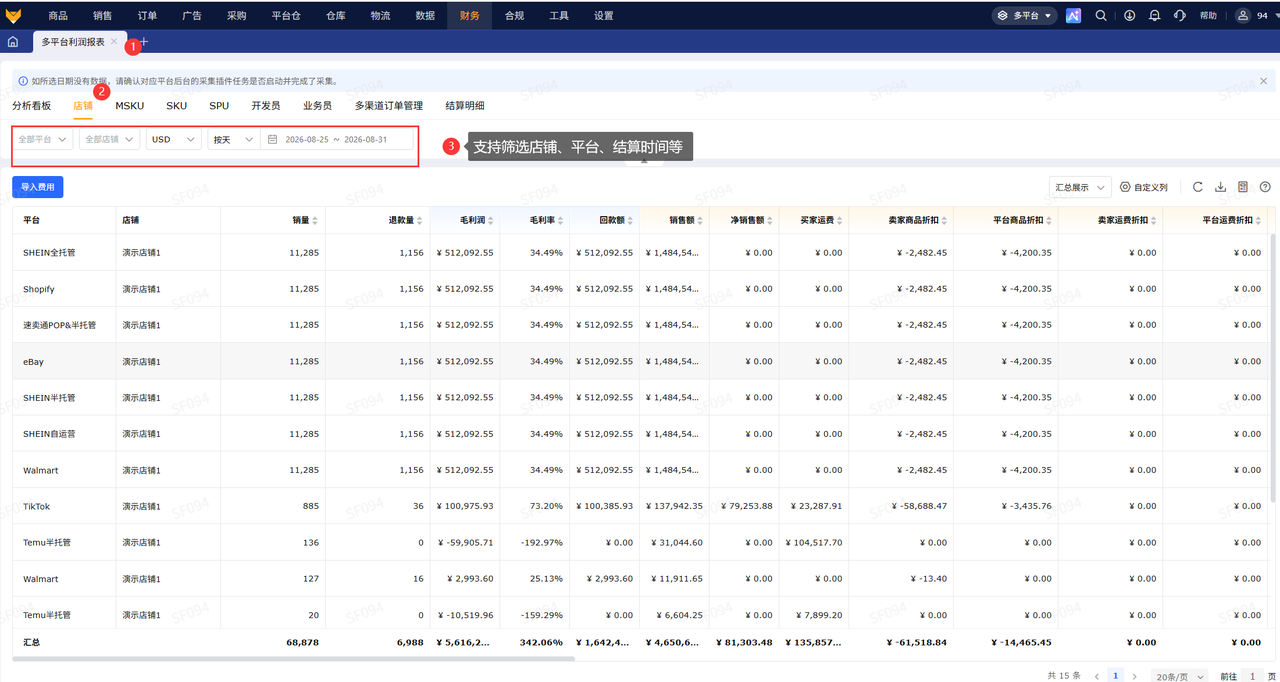
4.1 Shopee Profit Reports: Account for Every Cent
Key highlights:
- Automatic data collection eliminates manual report exports:Synchronize settlement details, order data, and fee lists from Shopee stores across marketplaces with one click, without manually exporting and combining multiple spreadsheets, substantially reducing reconciliation time.
- Precise product-level profit drill-down:Freely drill down into profit data across multiple levels, from MSKU and SKU to store, marketplace, and salesperson, to clearly identify which products truly make money and which are driving volume at a loss.
- Automatic cost matching and allocation: Procurement costs, first-leg shipping costs, platform commissions, transaction fees, advertising costs, and other expenses are automatically assigned to the corresponding orders and products. Shared expenses can be intelligently allocated according to various rules, so product-level profit is no longer a confusing calculation.
- Financial period closing locks data: After monthly profit calculations are completed, the financial period can be closed so that confirmed data no longer fluctuates with subsequent settlement changes, ensuring the stability and accuracy of financial reports.
How to use:After sellers authorize their Shopee stores in Saihu, the system automatically collects settlement data and order details from each marketplace. Sellers simply select the Shopee platform, store, and time period under the multi-platform menu "Finance—Multi-Platform Profit Reports" to view daily, weekly, or monthly profit data. Custom profit calculation formulas are supported, allowing sellers to configure calculation criteria for product costs, platform fees, logistics costs, marketing costs, and other items according to their own cost structure.
4.2 Shopee Advertising Management: Double Advertising Efficiency
Key highlights:
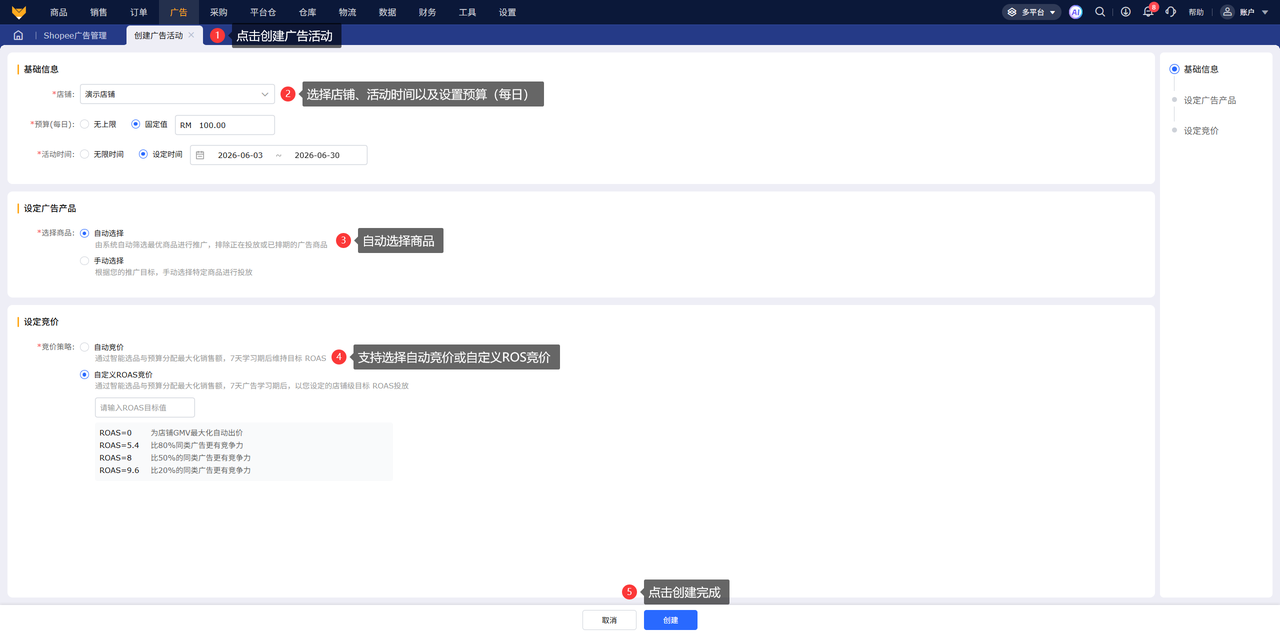
- Bulk ad creation across multiple stores and marketplaces: Manage advertising for authorized Shopee stores in one place, with support for bulk campaign creation across multiple stores and marketplaces. Configure stores, campaign schedules, and daily budgets centrally without logging into each backend individually, improving advertising efficiency and reducing costs.
- Automatic and manual bidding for flexible, controllable advertising strategies: When selecting products automatically, automatic bidding (intelligent bid adjustments by the platform) and custom ROAS bidding (manually entered ROAS targets) are supported. When selecting products manually, sellers can set bids for ad placements, choose broad-match or exact-match keywords, and enter the corresponding bids for precise control over promotion costs.
- Daily data updates make advertising performance clear at a glance: Initialize 90 days of advertising data, with automatic daily updates. Core metrics such as ad impressions, clicks, click-through rate, ad spend, conversions, and ACoS are displayed centrally. Custom field display and export are supported, enabling side-by-side comparisons of advertising performance across different stores and ad types.
- Bulk operations and manual synchronization keep ad status under control:Select advertising campaigns to enable, pause, or delete them in bulk. If data updates are delayed, synchronize manually to quickly adjust advertising strategies and capture traffic opportunities.
- Advertising logs provide traceable operation records: Advertising logs fully record advertising operations performed in Saihu, with filtering by store, operation type, status, and operator. Responsibilities are clear, facilitating team collaboration and advertising performance reviews.
How to use:Centrally manage advertising campaigns for all Shopee stores in Saihu's multi-platform "Advertising" module, with support for the full workflow, including advertising plan creation, advertising campaign creation, and data reviews. Sellers can filter advertising performance by multiple dimensions, including store, marketplace, ad type, bidding method, and advertising status, and make optimization adjustments directly within the ERP without switching between individual store backends.
4.3 Shopee Affiliate Marketing: Efficiently Expand Off-Platform Traffic
Key highlights:
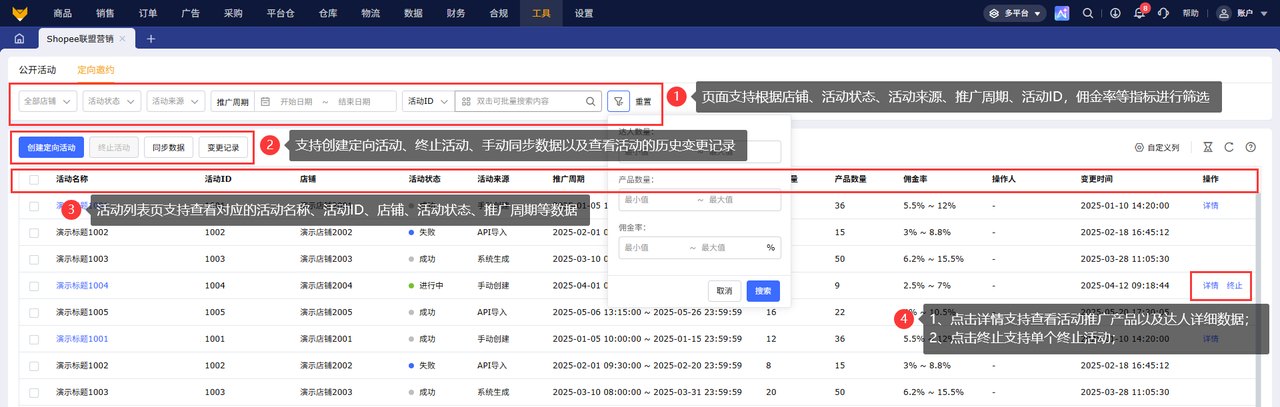
- Centralized management of affiliate programs across multiple marketplaces:View affiliate marketing data from all marketplaces in one place without logging into each Shopee backend individually to make comparisons, helping sellers develop differentiated affiliate commission strategies.
- Measurable campaign performance:Sales volume, sales revenue, commission costs, ROI, and other affiliate order data are clearly presented, helping sellers determine which products are suitable for affiliate channels and whether commission rates are reasonable, providing a stronger basis for pricing and promotion decisions.
How to use:In the "Tools—shopee Affiliate Marketing" module of Saihu's multi-platform system, sellers can centrally manage Shopee affiliate marketing programs across marketplaces, set promoted products and commission rates, and track orders and traffic generated by affiliate creators. Affiliate fees are automatically included in profit reports and calculated alongside product costs and advertising expenses to determine the actual profit of each product.
From accurate profit calculation and efficient advertising to off-platform expansion through affiliate marketing, Saihu ERP provides Shopee sellers with full-chain operational support after pricing. Pricing is the starting point, but operations are the true source of profit—only by using the right tools can every pricing strategy translate into tangible earnings.
Four. Quick Reference for Common Shopee Pricing Questions
Q1: Is the Shopee pricing formula fixed?
There is no single fixed formula. The core principle is to "work backward from total costs to determine the selling price." Specific parameters (commission rates, promotional event fee rates, return-related loss rates, etc.) vary by marketplace, category, and business model, so sellers need to adjust them based on their actual circumstances.
Q2: Should new product pricing prioritize low prices or profit?
During the new product stage, the primary goals are to gain reviews and improve the store's ranking weight. It is recommended to price products 5%-10% below established competing products, using price to compensate for the gap in review counts. However, the selling price must cover all costs and cannot fall below the break-even point.
Q3: How exactly does Shopee shipping cost embedding work?
Shipping cost embedding means incorporating the cross-border logistics costs borne by the seller into the product's selling price so that buyers see a lower shipping fee on the storefront.
The core formula is: Shipping cost to embed = SLS cross-border shipping cost actually paid by the seller - Shipping fee charged to the buyer on the storefront. Billing units differ across marketplaces, so do not apply a single template to all of them.
Q4: Can pricing be exactly the same across multiple marketplaces?
No. Commission rates, logistics costs, and buyers' purchasing power differ across marketplaces. It is recommended to calculate costs and set prices separately for each marketplace.
Q5: What should I do if traffic drops after a price adjustment?
Shopee is sensitive to price changes. Directly changing the base selling price may affect traffic ranking weight. It is recommended to adjust prices indirectly through discount promotions rather than frequently changing the base selling price. If a price adjustment is necessary, make several small adjustments and monitor changes in traffic.
Product link 1:Free cross-border e-commerce ERP registration portal
Product link 2:Claim 36000 orders for free with no prerequisites
Human customer support 3:Free real-time Q&A for cross-border e-commerce ERP
*Disclaimer: Some images, text, and materials on this website are sourced from the internet and are provided solely for discussion and learning. If any content infringes your rights, please contact us by private message, and we will promptly address it and remove it. Without authorization from this website, no organization or individual may reproduce, excerpt, adapt, or otherwise use this website's content.
Source: Original website · Read the original article
Related Learning
AliExpress · Featured
How to Operate a Local AliExpress Store? AliExpress Store Registration Process
In cross-border e-commerce, AliExpress, as China’s largest online B2C foreign trade platform, has at…
AliExpress · Featured
How to Analyze Competitors on AliExpress? How to Grow a New AliExpress Store
In e-commerce, especially on international B2C platforms like AliExpress, understanding and analyzin…
AliExpress · Featured
AliExpress Local Store Shipping Rules? AliExpress Official Website Entry
With the rapid growth of cross-border e-commerce, more and more merchants are choosing to join the A…