 EN
Selling Like Hotcakes on E-Commerce Platforms at 99 Yuan, with a 50% Return Rate: How Lucrative Is the AI Toy Business Drawing Big Tech's Attention?
A blind box costs an average of 99 yuan, while talking Tom Cat toys and plush bears range from 399 yuan to 3000 yuan; Taobao's annual data for 2025 shows that AI toy sales grew by more than 1600% year on year, but investment in the sector is cooling and return rates remain high.
A blind box costs an average of 99 yuan, but a talking Tom Cat toy or plush bear costs at least 399 yuan and can sell for as much as 3000 yuan.
Compared with designer toys, AI toys can cost dozens of times as much, making this a decidedly high-margin business. Unlike opening physical stores, which requires greater investment, AI toys have primarily taken off online.
According to Taobao's annual data for 2025, sales of AI toy products grew by more than 1600% year on year, and AI companion dolls were also selected among Taobao's top ten products of the year.
Recently, Pinduoduo officially added an AI toy category and launched a full-scale merchant recruitment drive. According to Pinduoduo's merchant recruitment announcement, AI toys can receive greater traffic support during "Double 11" and in everyday searches.
But the flip side is that investment across the AI toy sector is cooling sharply, products are highly homogeneous, and return rates remain high.
As platforms race to put AI toys on their shelves, will this business produce the next Pop Mart, or merely become a short-lived gold rush?
01 Adding AI Sends Prices Up Dozens of Times, as Pinduoduo Joins the "Gold Rush"
Compared with blind boxes priced at 99 yuan, AI toys clearly command higher spending per purchase. At a physical AI designer toy store, Tech Planet saw a Tom Cat AI toy whose price reached as high as 1999 yuan after a large model was integrated. Currently, relatively few AI toys have IP licenses. More products focus on emotional companionship and incorporate personas with different emotional traits.
Unlike buyers through offline channels, purchasers of AI toys on e-commerce platforms are more likely to come from the parent-and-child market.
Taobao and Tmall were the earliest to establish a presence in AI toys. As early as month 4 of 2025, the four major high-potential segments announced by Taobao and Tmall's toys and designer toys division included emotional value, physical manifestations of IP, the male consumer economy, and AI toys. These four areas were expected to become the industry's main growth drivers over the following 5 years.
JD.com's approach focuses more on "technology empowerment." It launched its independently developed "body-integrated intelligence" platform, JoyInside, to provide a "brain" for AI toys. JD.com's strategy is to build an integrated embodied intelligence ecosystem combining "hardware + software + services," attract brands to connect through its proprietary AI platform, and launch its own AI toys.
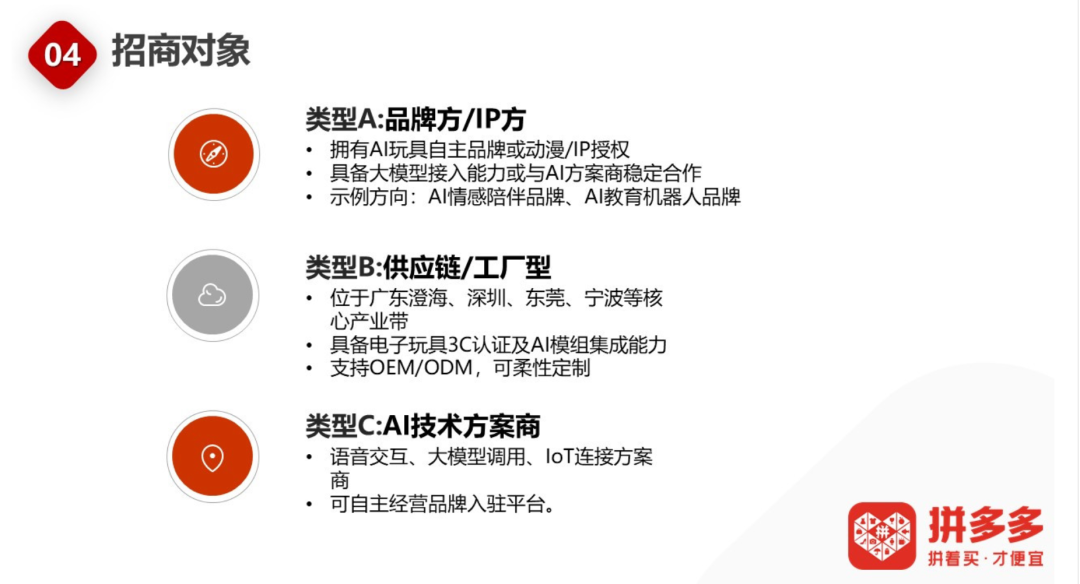
Caption: Pinduoduo's AI toy merchant recruitment content
For Pinduoduo, AI toys mean higher spending per purchase. In its merchant recruitment materials, Pinduoduo also stated that "the new opportunity in AI toys lies in AI features supporting a 300% price premium, allowing merchants to move beyond 9.9 with free shipping." Taking the currently popular product Fuzai as an example, its price starts at 399 yuan. Consumers in lower-tier markets "beyond the Fifth Ring Road" are also a primary audience for AI toys.
The Spring Festival sales figures are particularly telling. During the 2026 Chinese New Year Shopping Festival, sales in Taobao and Tmall's AI toy category surged to 500 times their year-earlier level, with a substantial share of the increase coming from county and township markets.
An AI toy industry practitioner told Tech Planet that in first-tier cities, purchasing decisions tend to center on educational investment or trying out new technology. Spending per purchase can reach thousands or even tens of thousands of yuan, and parents examine large-model capabilities, conversation quality, and educational content. In lower-tier markets, the decision-making logic is simpler: it is inexpensive, can talk with children, and is better than an ordinary toy.
According to disclosures by the Ministry of Industry and Information Technology, China's AI toy market reached 290 hundred million yuan in 2025, which industry insiders dubbed "the inaugural year of AI toys." The market is expected to reach 342 hundred million yuan in 2026.
Gift-giving has become a primary purchasing occasion. After this year's National Day holiday, data disclosed by some manufacturers showed that sales in the first half of this year had already exceeded those for the whole of last year. Some merchants have already made substantial profits, particularly in places with well-developed toy supply chains, such as Dongguan and Yiwu.
A leading AI toy manufacturer told Tech Planet that its products use the Doubao large model domestically and ChatGPT overseas, with an ex-factory price of around 100 yuan, and that 70% of its customers are in overseas markets. According to the manufacturer, last year it was the only one transitioning from ordinary plush toys to AI toys, while this year more than a dozen manufacturers are doing so.
Traditional toy manufacturing clusters have also seen a surge in business performance. The Chenghai Toy Association previously disclosed that in Chenghai, the region with the most developed AI toy industry, AI toys' share of exports by local toy enterprises above the designated size rose from less than 10% in 2024 to around 30% in 2025. In 2025, the total output value of Chenghai's toy industry exceeded 500 hundred million yuan.
02 High Return Rates and Homogeneous Products Make It Hard to Produce the Next Pop Mart
But the flip side is that a large number of brands seeking quick profits are flooding into this sector. Behind the explosive short-term growth, repeat purchases and user experience have not kept pace.
A parent who bought an AI toy described his observations to Tech Planet: AI toys on the market are highly homogeneous, with functions largely built around a few fixed modules—screen-based eyes, educational features packaged with an AI voice assistant and a persona, and simple movements such as dancing, waving, and twisting. More advanced models add mobility and obstacle avoidance similar to robot vacuum cleaners as a foundation, layered with limited personality development and evolution, as well as peripheral features such as photography and diaries.
“It feels like they basically all stay within this framework. I come across new products in my feed every day, but when I look closely at their features, I feel a little disappointed again,” the parent said.
Beyond homogenization, return rates also remain persistently high. Once the initial novelty wears off, AI toys quickly become desktop dust collectors. Several users who bought AI toys told Tech Planet about unstable internet connections, with even activation and connection taking a long time. One user added that she had recently bought a walulu for 599 yuan and spent a long time just trying to connect and activate it and maintain a stable network signal for conversations. She still could not figure it out and ultimately chose to return it.
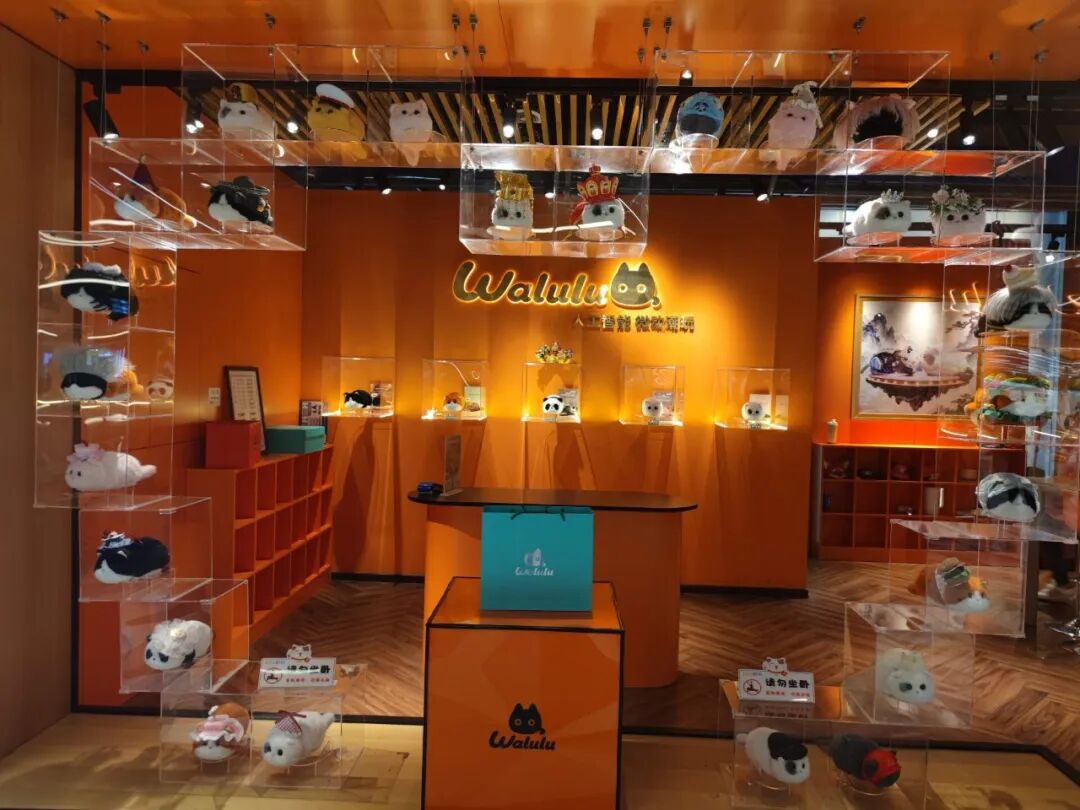
Caption: An offline AI toy store. Photo by Tech Planet
Industry reports show that AI toy return rates have consistently remained above 50%. On e-commerce platforms such as Taobao, JD.com, and Pinduoduo, some collectible toy companies have introduced conditional returns and exchanges to reduce return rates: once a product has been connected to the internet and activated, it can no longer be returned. However, this can also lead to a decline in sales.
The manufacturer mentioned above told Tech Planet that the following figures were circulating within the industry: a leading content creator with tens of millions of followers sold more than ten thousand units of an AI toy in a single livestream, with a commission rate of 50%, but the subsequent return rate reached 60%.
Although the domestic market, unlike overseas markets, is dominated by AI plush toys and seems closer to the collectible toy sector, it is actually difficult to define AI collectible toys as the next Pop Mart.
From a business model perspective, the competitive barriers for collectible toys lie in IP and aesthetics, while those for AI toys lie in large-model interaction capabilities, control over connectivity and computing costs, and a subscription service ecosystem.
Currently, AI toys mainly follow two models. One is more like the gaming industry: buying the hardware is only the starting point, and ongoing payments complete the business model. Take Fuzai as an example: daily conversation time is 30 minutes, and increasing the daily conversation allowance requires an additional payment. Fuzai uses a “hardware purchase + paid subscription” model. The product provides approximately 24 minutes of free interaction each day, with any additional time requiring a monthly or annual pass. A VIP annual pass costs 199 yuan, while an SVIP annual pass with unlimited energy points costs 299 yuan.
The other is a one-time purchase model. After paying for the hardware upfront, users incur no recurring subscription expenses. Prices are usually higher; for example, one Talking Tom product costs 1999 yuan.
Fuzai founder Sun Zhaozhi has publicly stated that the hardware itself has a healthy gross margin that can cover hardware costs. Software costs include Token costs, cloud service costs, RTC technology fees, and more. The company covers these costs through membership subscription fees and revenue from value-added services.
He also noted that Token costs account for a relatively small share of Fuzai's costs because the manufacturer routes tasks to different models. Everyday conversations use a low-cost model specifically optimized for role-playing, while only tasks requiring strong reasoning capabilities, such as “personality evolution,” call on the most expensive model. Such tasks account for an extremely small proportion.
03 A low-price war begins: AI toys priced at 99 yuan become hot sellers on e-commerce platforms
The head of an AI toy manufacturer told Tech Planet that parents and children remain the primary market. On the one hand, the voice interaction capabilities of current AI collectible toys struggle to meet adults' needs, and the experience can be less satisfying than simply continuing to look at a phone. On the other hand, AI toys emphasize companionship, but adults find it difficult to let their guard down and freely discuss their feelings and secrets with an AI toy.
The executive also said that, unlike in the collectible toy industry, electronic pet-style products sell better, typically AI toy cats, because their ears and tails can move when touched, attracting children's attention more quickly.
Currently, few AI toys feature collaborations with well-known IPs. The main reason is not a lack of collaboration opportunities, but that IP owners are reluctant to grant licenses and manufacturers are not equipped to handle them.
The most immediate obstacle is the conflict between AI's “uncontrollability” and IP owners' insistence on strict character consistency. Content generated by large AI models involves randomness, while well-known IPs, developed over many years, have strict specifications for their characters' personalities, speaking styles, and values. If an AI toy bearing a character's likeness says something inappropriate, the damage to the IP could be devastating.
This is not an unfounded concern. Hasbro, the parent company of Peppa Pig, set up a dedicated AI team and spent a year developing a contractual framework. It also explicitly stipulated that, for now, AI should be used only in business-facing applications rather than directly targeting consumers, because consumer-facing AI interactions carry “extremely high risks.”
Traditional collectible toys sell the “pleasure of ownership” and “collectible value,” while AI toys sell “companionship.” Scarcity is the underlying logic behind the soaring value of Pop Mart's LABUBU. AI toys, however, rely on general-purpose large models and have highly similar interaction logic, diluting scarcity. Their ability to command a premium is not on the same footing as that of traditional collectible toys.
A user who bought a Walulu told Tech Planet that it is an AI toy closely resembling a real pet cat. But after it arrived, the oversized zipper and the mechanism built into it seemed to tell him that its target users were children under six. Moreover, AI toy prices currently need to stay within a range ordinary parents can afford, which means using relatively poor hardware and models, ultimately making the conversational experience of very limited value.
Upstream order volumes also tell the story more clearly. A factory owner in Guangdong told Tech Planet that the factory had recently received many sample orders for AI toys, but bulk orders were generally stuck at the minimum order quantity, and repeat orders were hard to secure, mainly because the toys offered limited interactivity and a weak sense of companionship.
An AI toy industry professional told Tech Planet that the industry needs a product like Disney's Olaf; otherwise, breakthroughs will be difficult. Most current AI toys simply combine old features with Doubao/Qwen and put them inside a toy casing, like a Tmall Genie dressed in doll clothes. AI toys on the market all have the same features, so competition comes down to which is easier to use and more visually appealing. Leading companies are riding the hype to attract investment, while small and medium-sized manufacturers sell core modules to downstream businesses to incorporate into their products. Almost all are sitting on inventory, and only a handful have real sales and healthy cash flow.
Olaf was jointly developed by Disney, NVIDIA, and Google DeepMind. Rather than offering "screen eyes + a voice assistant + simple movements," every technology in the Olaf robot serves a single purpose: to make you believe it really is Olaf. Users become immersed in the character rather than feeling that they are using an AI feature.
But this also reveals its limitations. Olaf currently cannot truly hold autonomous conversations. It plays lines prerecorded by a voice actor, triggered by a backstage operator according to the situation on site. In other words, its "intelligence" is performed, not a general-purpose capability.
When AI toys first took off, a product was generally priced at 399 yuan. But over the past year, AI toys priced at around 99 yuan have become big sellers on e-commerce platforms. Without an unassailable core competitive moat, price wars have become the most direct signal. Meanwhile, brands such as Fuzai have now begun selling accessories such as doll clothes in their stores, rather than focusing on product innovation.
The ultimate form of AI toys is still being explored, and the industry needs to reach a tipping point.
By | Lin Jing
This article was originally published / published with authorization on Renren Dou Shi Chanpin Jingli by its contributing author [Tech Planet], WeChat official account: [Tech Planet]. Reproduction without permission is prohibited.
Header image from Unsplash, under the CC0 license
Source: Tech Planet · Read the original article