 EN
A New Traffic Entry Point Is Emerging! Amazon Adds AI Summaries to Its Customer-Facing Pages
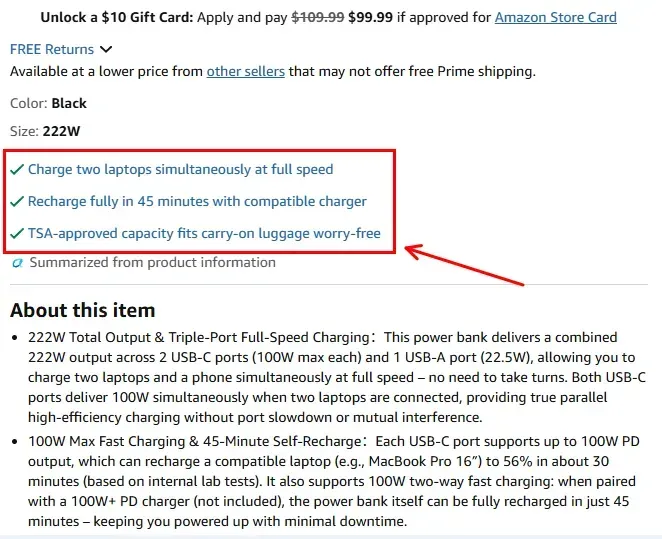
Recently, Amazon’s customer-facing pages have changed again, and a new traffic entry point is emerging.
AmazonA New Traffic Entry Point Is Emerging
Recently, some sellers have noticed a new product information summary module on Amazon product detail pages.
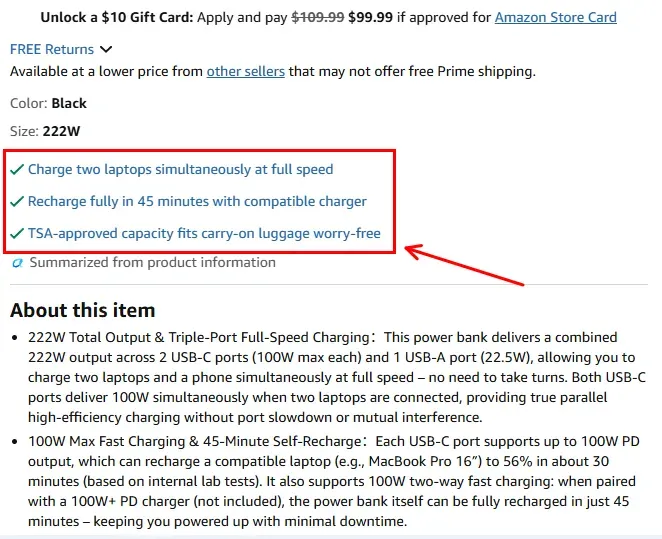
The module usually consists of three short points, each with a green check mark beside it, with the label below:
“Summarized from product information”
In other words, it is a summary generated from product information.
Simply put, a new AI summary is appearing on product pages: product information is condensed into a few brief selling points, and buyers can click through and continue chatting with Alexa to learn about the product’s features.
Compared with the five bullet points sellers fill in through Seller Central, these statements are shorter and more direct. On some mobile pages, they may also appear before the existing five bullet points.
Based on seller feedback so far, this display has not yet been consistently rolled out across all marketplaces, accounts, and ASINs.
The same product page may show the following differences:
- One buyer account can see it while another cannot;
- It may be visible on mobile but not yet on desktop;
- The display may differ after changing browsers, regions, or login status;
- Some ASINs show three summary points, while others retain the original page;
- The display position or content for the same ASIN may change when viewed at different times.
Therefore, a more accurate way to put it is:Amazon is displaying AI-generated product information summaries on some product detail pages. The feature is in the testing phase, and sellers should continue to monitor it.
1. Core selling points may be reordered
If the first bullet point spends a lot of space describing packaging, appearance, or accessories, while compatibility, size, material, and use cases that genuinely influence purchase decisions are buried further down, AI may pick up secondary information and miss the key advantages.
Sellers need to review:
If you could describe the product in only three sentences, would your currentListinghelp the platform accurately identify the three most important points?
2. Keyword stuffing may interfere with understanding
Some sellers still habitually repeat similar keywords across the five bullet points, and may even write unnatural, lengthy sentences to cover search terms.
This not only makes the content harder for consumers to read, but may also make it harder for AI to identify the product’s true key points.
Keywords still need to be included, but they should be incorporated naturally into complete, clear product information.
3. Conflicting information between variations poses greater risks
Some sellers have reported on the Amazon Seller Forums that AI summaries incorrectly cited information from another child ASIN in the same variation family.
For example, a parent listing may include both a “short” and a “long” version, but the summary on the short-version page may mention features that apply only to the long version.
Official moderators on the Amazon forums have also advised sellers to further emphasize specification differences in the bullet points and product descriptions for different child items.
4. Unsupported claims may be prominently displayed
If a page contains unsupported claims such as “100% effective,” “absolutely safe,” “permanent use,” or “completely eco-friendly,” AI may extract them into a more prominent summary.
- Start with a self-check: Using a buyer account and a mobile device, regularly open your own ASIN and check whether the 3 AI-generated summary points are accurate and whether they contain errors, exaggerations, or non-compliant claims.
- Streamline the five bullet points: Put the selling points first, placing the most important conversion-driving point in the first bullet; keep sentences concise, avoid long sentences and vague claims, and ensure consistency.
- Complete backend attributes: Structured attributes in the backend (material, size, and function) are an important source for AI extraction. Do not rely on the five bullet points alone to convey information.
- Align variation information: Keep specifications and descriptions consistent across parent variations to avoid conflicting content being extracted by AI.
- Check for compliance: Remove vague environmental terms and absolute claims from the five bullet points, attributes, and A+ content to prevent AI from extracting non-compliantcontentonto the customer-facing page
A significant change is taking place on Amazon product pages:
Buyers may not read product information in the traditional order of title, images, bullet points, and A+ content. Instead, they may form an initial judgment quickly through AI summaries, Q&A, and comparison features.
This does not mean keywords have become ineffective, nor that traditional Listing optimization is outdated.
What has really changed is that sellers can no longer focus solely on “how many keywords they have included.” They also need to consider three questions:
Can buyers understand it?
Can search systems recognize it?
Will AI summarize it incorrectly?
A Listing better suited to future shopping pages should have the following characteristics:
- Clear selling points, with important information up front;
- Concise sentences, each covering just one key point;
- Specific parameters, without using vague adjectives in place of facts;
- Consistency across the title, bullet points, attributes, images, and A+ content;
- Clear enough differences between variants;
- Evidence to support all claims about benefits and promotional statements;
- Clear statements of applicable conditions and limitations.
Source: Sutuizhanwai · Read the original
Related Learning

Financing solutions for Amazon sellers
Financing solutions for Amazon sellers Financing solutions are crucial when it comes to scaling your…

Asia–Europe Freight Rates Fall for 13 Consecutive Weeks as US and European Routes Weaken Across the Board
AMZ123 has learned that the latest assessment of Drewry's World Container Index shows freight r…
Amazon ASIN: What It Is, How to Find It, and How Sellers Use It
Table of Contents What Is an ASIN? How Do ASINs Work in Amazon’s Product Catalog? How Can You Find a…